Tiếng Việt
News, Consulting, Solutions
Industrial Robot Types: Characteristics, Classification, and Applications

Industrial robots, particularly robotic arms, have become the core of modern manufacturing automation. From complex automotive assembly lines to sophisticated food packaging processes, the presence of robots optimizes productivity and quality. However, selecting the right type of robot for a business is not straightforward. The current market offers countless types, each possessing distinct characteristics, motion structures, and applications.
This article from Servo Dynamics will provide a comprehensive overview of industrial robot types, helping you understand their operating principles, classification methods, and make the smartest investment decision.
What is an Industrial Robot?
An Industrial Robot is a multi-functional, programmable mechanical device designed to move materials, parts, tools, or specialized equipment through programmed motions to perform various tasks in a production environment.
The main goal is to replace or assist humans in performing repetitive, dangerous, or high-precision tasks.
Characteristics of Industrial Robots
Modern industrial robots are defined by four key technical factors:
- Mechanical Structure: This is the physical framework of the robot, including links and joints, which determines its shape and working envelope. This structure must ensure rigidity, load capacity, and durability.
- Controller: This is the brain of the robot, containing the programs and algorithms that control the movement of the axes. The controller receives signals from sensors and sends commands to the actuators.
- Degrees of Freedom (DOF): Represents the number of independent movements the robot can perform. Each movement axis (linear or rotational) corresponds to one degree of freedom. A 6-DOF robot is the most common type because it fully simulates the movements of a human arm.
- Payload – Speed – Accuracy and Repeatability: These are critical performance indicators:
- Payload: The maximum mass the robot can carry at its end-effector.
- Speed: The maximum operating speed of the robot.
- Accuracy and Repeatability: The robot’s ability to move to a programmed point and its ability to return precisely to that point after multiple repetitions.
Industrial Robot Components
A complete industrial robot typically includes the following components:
- Robot Body/Base: The stable base, usually fixed.
- Actuators/Drive System: The parts that generate movement, including electric motors, gearboxes, and braking systems.
- Arm and Wrist: A series of links and joints responsible for primary movements and end-tool orientation.
- Sensor System: Provides data about the environment (vision, force, contact) and the robot’s internal state, allowing for flexible reactions.
- Controller: The central unit where the robot’s control program is stored and executed.
Industrial Robot Types (Classification)
Classification by Motion Structure
This classification is based on the geometry of the robot arm and its working coordinate system, which determines the working area and flexibility of the robot:
| Robot Type | Structural Characteristics | Working Coordinate System | Typical Applications |
|---|---|---|---|
| 6-DOF Articulated Robot | Structure similar to a human arm, multiple rotary joints. | Spherical coordinates (most flexible). | Welding, painting, assembly, complex material handling. |
| SCARA Robot | 2 parallel rotary joints (X-Y) and 1 linear joint (Z). Fast speed, rigid along the Z-axis. | Cylindrical coordinates (selective compliance). | High-speed Pick & Place, light component assembly. |
| Cartesian/Gantry Robot | Moves along 3 perpendicular linear axes (X, Y, Z). | Cartesian coordinates. | 3D printing, CNC machines, large area pick & place. |
| Delta/Parallel Robot | Light arms connected in parallel to a central axis. | Parallel coordinates. | Extremely high speed, food packaging, pharmaceuticals. |
| Cylindrical Robot | 1 rotary joint and 2 linear joints. | Cylindrical coordinates. | Spot welding, operating die-casting machines. |
| Polar/Spherical Robot | 2 rotary joints and 1 linear joint. | Spherical coordinates (long reach). | Die casting, welding, heavy material handling. |
Classification by Function
- Industrial Welding Robot: Specialized for arc welding and spot welding, ensuring quality and speed.
- Painting Robot: Performs spraying and material coating with high uniformity and precision.
- Pick & Place Robot: High-speed robot used to move components or products.
- Assembly Robot: Used for assembling small parts, requiring high precision and delicate force handling.
- Handling Robot: Autonomous Guided Vehicles (AGV/AMR) or high-payload robot arms used for material movement.
- CNC Machining Robot: Performs automatic loading/unloading (Machine Tending) for CNC machines.
Classification by Brand
The market is led by major established brands and collaborative robot manufacturers:
- Universal Robots (UR): Pioneer and leader in 6-axis collaborative robots (Cobots), notable for safety, ease of programming, and low Total Cost of Ownership (TCO).
- ABB: Offers a diverse range of industrial robots for various applications.
- FANUC: Known for its durable and reliable yellow robots, strong in the automotive industry.
- KUKA: Strong in heavy automation solutions, known for its orange robots.
- Yaskawa Motoman: High-speed robots for welding and material handling.
- Mitsubishi: Provides SCARA and mini-robots for precise applications.
Industrial Robotic Arms
What is an Industrial Robotic Arm?
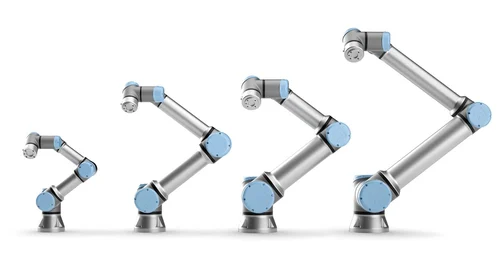
A robotic arm is an industrial equipment used to carry out repetitive tasks through a programmed motor. A robotic arm is primarily made up of a set of joints that allow the arm to access different locations in the space around it.
Typically, a robotic arm will have joints, actuators, and manipulators as some of its main components. The robotic arm is designed to replicate the motion of an actual human arm to the greatest extent possible. A robotic hand can be a standalone equipment used for individual tasks or can also be used as part of an extensive and more comprehensive machine. Many robotic arms that are used in different industries around the world are mounted on benchtops and can even be modular. Other robotic arms are portable and can be programmed to do a wide variety of tasks.
An essential requirement for the operation of robotic arms is programming. Modern robotic hands are created to perform multiple sets of tasks. They are built to be versatile and carry out different tasks based on the input given by the programmer.
Among the major concepts associated with robotic arms, a feature that stands out is the ‘degrees of freedom’. Degrees of freedom represent the number of dimensions each joint of a robotic arm can rotate and translate. The degrees of freedom of the joints of a robotic arm are determining factors for its flexibility and versatility. They determine the fraction of the surrounding volume that the robotic arm will be able to access and the types of tasks it will carry out.
| Learn more: Industrial Robotic Arms – Explained: Components, Operation, Types, Advantages, and Selection |
A collection of robotic devices is collectively referred to as “robotic arms.” The uses of these several robot types frequently overlap. However, each kind has unique features that often allow it to be more effective than other robotic arms for particular jobs. Various robotic arm types include:
- Articulated arm
- Six-axis arm
- Collaborative robot arm
- SCARA arm
- Cartesian arm
- Cylindrical arm
- Spherical/Polar arm
- Parallel/Delta arm
- Anthropomorphic arm
- Dual-arm
Types Of Robotic Arms And Their Uses
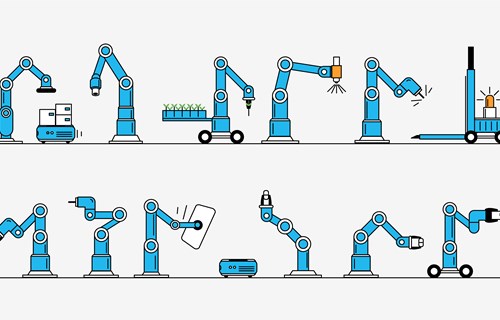
Types of robots in industrial use can be classified based on their technology, axis configurations, the tasks that they need to perform, payload factor, speed, and the needed range of motion. Constant advancements in robotic technology have reduced the cost and the size of robots, allowing them to execute tasks in smaller-scale applications while reducing their footprint.
An important basis of classification that we need to understand is the number of axes. These determine the degree of freedom that the robot can work in. For example, if a robot can work across the X, Y, and Z planes, it is said to have a degree of freedom of three. The higher the degrees of freedom, the more the functionality of the robot.
The following are the types of robots used for various industrial applications:
Articulated Robot Arm
An articulated robot arm resembles the human arm and allows mechanical movement and configuration. It is one of the most common types of robotic arms for industrial automation. It features a single mechanical arm attached to a base with a twisting joint.
Six-axis robots are the most common type of articulating robot, and they generally feature four to six axes, allowing for a wider range of motion. They can automate many different robotic applications, including arc welding, spot welding, painting, assembly, material removal, material handling, palletizing, and many more.
Cartesian/Gantry Robot Arm
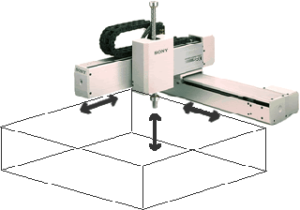
Cartesian robots are the most commonly used industrial and commercials robots. These robots allow motion along three orthogonal axes – X, Y, and Z, and these motions are coordinated using a common motion controller.
A Cartesian robot uses only one linear actuator for each of the axes. These robots can only move in straight lines and are incapable of rotating.
Cartesian robots are mainly used in computer numerical control machines (CNCs), milling and drawing machines.
There are plenty of reasons why Cartesian robots are losing their popularity. They require a large volume to operate economically and are quite rigid in their deployment. The assembly requirements of Cartesian robots are complex. They also require an ample and confined floor space to operate.
Cylindrical Robot Arm
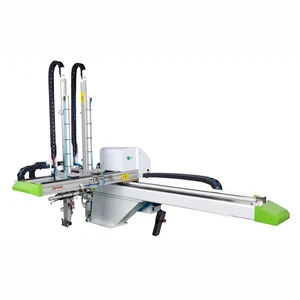
Cylindrical robots are quite similar to Cartesian robots, except that they operate within a cylindrical work envelope. Cylindrical robots have one angular movement and two linear movements. The cylindrical robot has a rotary joint along the joint axis for circular motion and a prismatic joint for linear motion. It is chosen for its economical use of space and the ability to reach small openings in cylindrical objects.
Cylindrical robots are relatively inexpensive, flexible, compact in size, and can work well in conditions unsuitable to humans. They are typically used to simulate human activities like assembly operations, spot welding, handling heavy materials, handling die casting machines, and handling machine tools. They are simple to use and install and are generally available as complete solutions with minimal assembly. Cylindrical robots have one significant drawback – they cannot rotate a full 360 degrees due to mechanical design limitations.
Delta Robot Arm
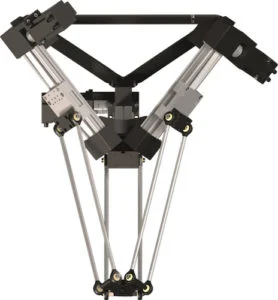
Also known as Parallel Link Robots, Delta robots are very different from the other types of robots mentioned above. A Delta robot uses three or four lightweight arms, which are connected via a ball-joint to a central hub. This gives it the appearance of a spider. The arms are jointed in the middle, bending inwards. They are all connected to a tooling plate, to which the end-effector is attached. Each arm is connected to a motor situated in the hub, creating coordinated movements for the arms, pushing the elbows inwards or outwards, while the hub remains parallel to the work surface.
Delta robots have a limited work envelope but can achieve high speed and acceleration in the assembly line. With technical improvements in motion control, vision guidance and conveyor tracking, delta robots are gaining usage in a variety of industries like FMCG, electronic components manufacturing, solar energy cells manufacturing, food, pharmaceuticals packaging, and medical devices manufacturing.
The main drawbacks of Delta robots are the high cost, need for extensive training for operation, and the possibility of the payload slipping due to high-speed motion.
Polar or Spherical Robot Arm
Polar robots, also known as spherical robots, feature a base coupled to an arm with two rotational joints and one linear joint. The robot’s axes combine to create a polar coordinate, enabling it to have a spherical work envelope. One of the first industrial robot categories to ever be created is the Polar Robot. Die casting, injection moulding, welding, and material handling are popular uses for polar robots.
SCARA Robot Arm
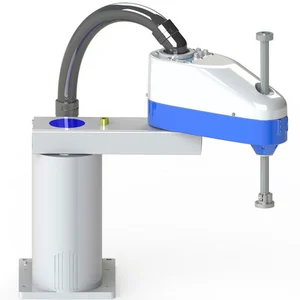
SCARA stands for Selective Compliance Articulated Robot Arm. SCARAs are the fastest of all industrial robots. They come equipped with linear X, Y, and Z axes along with the rotary motion of cylindrical robots. SCARAs have four degrees of freedom. They have a cylindrical work envelope with variations in the diameter and depth of the cylinder.
The arm in the SCARA is selectively compliant in the X-Y axis, but rigid in the Z-axis, making SCARAs ideal for fast, repeatable, and point-to-point movements. SCARA joints are all capable of rotation and can be thoroughly sealed and safeguarded, which is very important before deployment in dusty or corrosive environments, or for underwater applications.
SCARAs are ideal for modern assembly work, where fast movement with light payloads is required. Some of the tasks that SCARAs are particularly good at are Pick & Place, Laser Engraving, Soldering, and 3D Printing. SCARAs can work in high-speed assembly and are faster than all other robot types except the Delta class of robots. The main disadvantages of using SCARAs is that they are limited in movement, are higher priced, and have a large work envelope with a portion that they cannot reach.
Six-Axis Robots
Six-Axis Traditional Robots
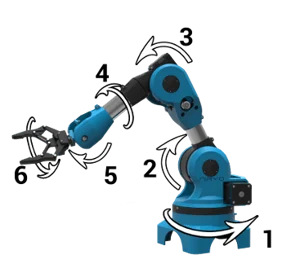
As the name suggests, 6-axis robots can move in 6 planes, meaning that they have six degrees of freedom. Along with the regular X, Y, and Z planes, these robots also allow pitch, yaw, and roll movements. Their programming is more complicated compared to other industrial robots. 6-axis robots have an unmatched ability to make movements where the other robots cannot reach. This superior ability for movement allows these robots to mimic a human arm as a whole. They are widely used in the automotive and aerospace industry, where they can be used to weld, palletize, drill, screw, paint and apply adhesives with ease.
In comparison to the above robots, 6-axis robots have mobility, are easier to move or mount, and have a wide vertical and horizontal reach. 6-axis robots cost more since they usually have proprietary controllers for executing complicated tasks and require more programming for making complex movements. Additionally, traditional six-axis robots require a large amount of space for cages and safety scanners, as they have the potential to injure humans who cross the robot’s path of movement. This often makes them difficult to deploy for manufacturers who do not have a large amount of space on the factory floor.
Collaborative Robot/Cobot
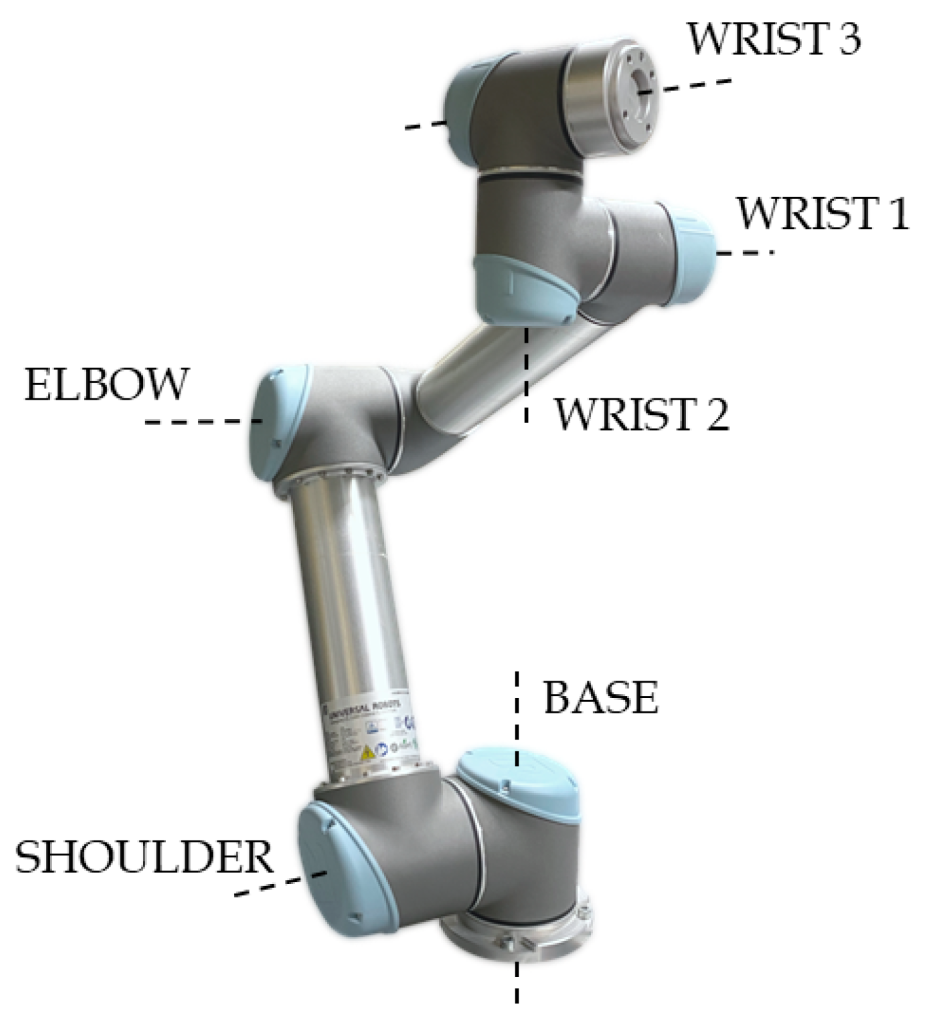
The increased sophistication of the supply chain, more intelligent control systems, AI and ML-based programming, integration with Industry 4.0 ready assembly lines, and automation of the entire production cycle has led to the increased use of collaborative robots, or cobots.
Unlike their traditional six-axis robot predecessors, cobots are built on the concept of Human Robot Collaboration, and enable safe physical interaction with humans in a shared workspace. This is thanks to their advanced safety features, primarily a protective stop that is activated when a person comes in contact with a cobot to ensure there is no injury. Cobots are small, and take up lesser space, especially because they usually don’t need cages because of their safety features.
In fact, the UR3 from Universal Robots can even easily be mounted on a table because of its compact size. The programming is also simple, with setup for a basic cobot application often taking less than a single day. All this makes them the automation solution of choice for an increasing number of manufacturers. Furthermore, Human Robot Collaboration is a key tenet and lever of Industry 4.0 and thus, cobots enabling large and small manufacturers alike to take a step in the direction of the latest industrial revolution.
Cobots help humans by handling highly repetitive, difficult, painful and dangerous tasks, increasing productivity and efficiency of the manufacturing process. This frees up the time of human operators to concentrate on the most qualified tasks with the highest added value. In fact, workers are often taught to handle the cobot and upskilled to handle tasks that require human ingenuity, thereby eliminating the mental and physical stress they may have been facing before the introduction of cobots.
Their flexibility and versatility of collaborative robots means that they are used in an array of industries for a multitude of applications, ranging from machine tending and quality inspection to packaging and palletizing.
| Learn more: What is a 6-Axis Robot? Structure, Operating Principles, and Applications |
Comparison: 6-Axis vs. 3-Axis Robots
A 3-axis robot operates based on the X-Y-Z spatial coordinate system, allowing movement forward/backward, left/right, and up/down. In contrast, a 6-axis robot has a more flexible articulated arm, mimicking human arm movements. It can rotate, fold, and move along a path, enabling the robotic arm to grasp objects at various angles, as well as flexibly rotate or tilt components. Therefore, a 6-axis robot is the ideal choice for more complex pick-and-place applications. However, this often comes with a higher cost.
For small and medium-sized manufacturers exploring automation, the choice between a 3-axis or 6-axis robot primarily depends on operational requirements and budget. If only simple tasks like picking and placing components into a mold are needed, a 3-axis robot may suffice. However, a robot is a long-term investment that needs to meet current and future needs.
Simple processes today may become more complex in the future. Additionally, robot application may open up new automation opportunities that demand greater movement flexibility. Fortunately, you don’t have to choose between price and features if you can own a 6-axis robot at a price comparable to a 3-axis robot.
How to Own a 6-Axis Robot at the Price of a 3-Axis Robot
With Universal Robots, you don’t have to compromise between cost and performance. As the leading manufacturer of collaborative robots, we offer 6-axis robot lines at competitive prices, optimizing production. Easy to program, safe to work alongside humans, and suitable for multiple applications, UR robots help small and medium-sized enterprises deploy automation effectively without excessive cost.
Servo Dynamics – Official Distributor of Universal Robots in Vietnam
Servo Dynamics proudly serves as the official distributor of Universal Robots in Vietnam. We are committed to providing high-quality collaborative robot solutions, along with professional consulting, installation, and technical support services, helping customers maximize the potential of Universal Robots.
Operating Principle and Control of Industrial Robots
Operating Mechanisms
- Joint Space Control: The controller calculates the position, velocity, and acceleration for each joint for the robot to move.
- Cartesian/Path Control: The robot moves its end-effector along a defined straight or curved path in space (X, Y, Z coordinates). Commonly used for welding, cutting, painting.
- Sensor-driven Operation: The robot adjusts its movement in real-time based on data from vision sensors or force/torque sensors, which is the core mechanism of safe collaborative robots.
Industrial Robot Programming
- Robot Programming Languages: Can be proprietary manufacturer languages or intuitive graphical interfaces (like Universal Robots’ interface) that allow even non-specialists to easily program.
- Offline – Online Programming:
- Online (Teach Pendant): Using the controller to manually move the robot to each point.
- Offline: Creating the program on 3D simulation software.
- Hand-guiding Programming: An exclusive feature of UR Cobots, allowing users to physically guide the robot arm to the desired positions for programming, which is highly intuitive and fast.
- Robot Controller
- Functions: Processes programs, controls motors, manages I/O, and ensures the safety of the entire system.
- Common Controller Types: Traditional controllers (large, proprietary) and integrated controllers (compact, integrating advanced safety features, easy system communication, typical in Cobots).
Applications of Industrial Robot Types Today
In Mechanical Manufacturing
- Welding: Automation of arc welding and spot welding processes.
- Cutting: Laser cutting, plasma cutting with high precision.
- CNC Machining: Automated parts loading/unloading (Machine Tending), increasing machine efficiency.
In Automation Lines
- Pick & Place: Optimizing the speed of component movement.
- Packaging: Fast, flexible product packaging.
- Palletizing: Large-payload robots automatically stacking boxes onto pallets.
In the Electrical – Electronics Industry
Assembly of micro-components, quality inspection using vision, chip mounting, and PCB soldering.
In the Automotive – Motorcycle Industry
Spot welding, painting, body assembly, quality inspection using vision robots (primarily 6-axis robots).
In the Food Processing – Logistics Industry
Handling sensitive food products (UR Cobots), packaging, warehouse organization, and goods transportation by Autonomous Mobile Robots (AMR).
Advantages and Limitations of Industrial Robots
Advantages
- Increased Productivity: Robots work continuously 24/7, maintaining stable production cycles.
- Reduced Errors: Superior accuracy and repeatability, minimizing waste.
- Continuous Operation: Can work in dangerous or harmful environments where humans cannot.
Limitations
- Investment Cost: Initial cost for traditional robots, safety systems, and integration can be high.
- Need for Operating Personnel: Requires personnel specialized in programming and maintenance. (However, collaborative robots like UR have significantly lowered this barrier).
Industrial Robot Market in Vietnam
Demand – Growth Rate
Vietnam is a market with rapid growth in automation. The need for digital transformation and enhanced competitiveness is driving businesses to invest in robots, especially flexible, easily integrated, and cost-effective solutions.
Strong Application Sectors
- Mechanical: Welding, machining, and automated part loading applications.
- Electrical – Electronics: Sector requiring high precision and speed in assembly.
- Logistics: Growing demand for warehouse automation and cargo handling.
How to Choose the Right Robot Type for Your Business
Determine Needs and Applications
The first step is to clearly define the specific task and working environment of the robot.
Selection by Axis – Payload – Reach
- Number of Axes: The more complex the task, the more axes are needed (usually 6 axes).
- Payload: Must be greater than the total mass of the object and the end-tool.
- Reach: Must ensure the robot can access all necessary working points.
Calculate Investment – Operation – Maintenance Costs
The Total Cost of Ownership (TCO) must be evaluated. 6-axis collaborative robots from Universal Robots offer a competitive advantage in TCO due to low integration costs, no need for safety caging, and short programming time.
Servo Dynamics Engineering: Authorized Distributor of Universal Robots in Vietnam
Servo Dynamics Engineering is proud to be a strategic partner and the official Authorized Distributor of Universal Robots in Vietnam.
We are committed to supplying the world’s leading 6-axis Cobot lines along with specialized consulting services, dedicated technical support, and comprehensive integration solutions. We help Vietnamese businesses deploy automation quickly, safely, and efficiently, ensuring maximum Return on Investment (ROI) even with the initial investment budget of a traditional 3-axis robot.
Industrial robots, especially 6-axis Collaborative Robots (Cobots), are the key to modernizing production. We hope this article has helped you gain a better understanding of the types of robot arms available in the market.
Every industrial company needs tools to increase labor productivity, meet changing demands, and optimize costs. The expert team at Servo Dynamics is always ready to assist you in maximizing the potential of robots. Contact our specialists now to find the most suitable Universal Robots automation solution for your business!
The robotic arm is a significant piece of the robotic machinery industry. The different types of robotic arms tend to fascinate the audience with their speed and strength. However, the usage and application of the same remain a mystery to many. This article will broadly speak about the different robot arm types and their industrial applications to provide you with a better understanding of efficient decision-making. So, keep reading.
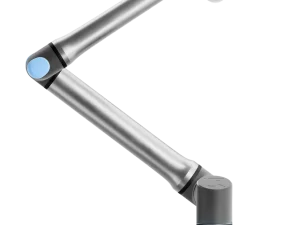
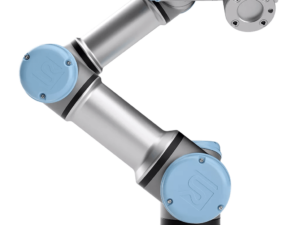
Explore the products of Universal Robots


Learn more
Servo Dynamics Became An Authorized Distributor of Universal Robots in Vietnam
About Universal Robots Founded in 2005 in Denmark, Universal Robots (UR) is a pioneer in [...]
Dec

Universal Robots| Cobots reduce employee lifting by 50%
Challenge As one of the world’s largest meat producers, Danish Crown faces significant challenges in [...]
Dec

Universal Robots first launch its “Collaborative Robots” in Vietnam – Introduce local distributor
Universal Robots (UR), a Danish manufacturer of smaller flexible industrial robot arms, based in Odense, [...]
Jul

How cobots are supporting the elimination of blindness
The challenge Among the solutions that Aurolab provides to NGOs and hospitals globally is their [...]
Nov

UR20 Frees Up Employees from Unergonomic Palletizing Tasks at Ornua
We looked at palletizing as the first area to explore automation due to the number [...]
Nov

L’Oréal automates hair research centre
The Challenge ‘In our MTI (Innovation Methods and Techniques) department, we collect data on the [...]
Oct