Tiếng Việt
Consulting, Industrial Automation
What is Industrial Wireless? Classification, Applications & Optimal Device Selection

What is Industrial Wireless?
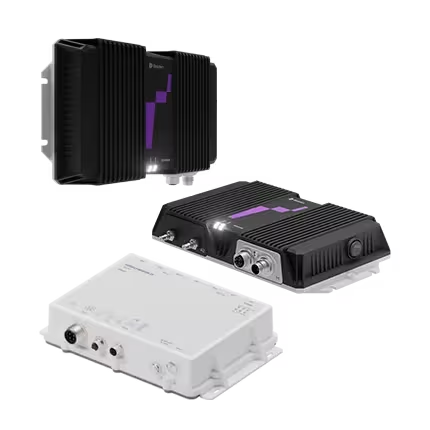
Industrial Wireless is a specialized wireless communication system designed to operate and maintain connectivity in harsh Operational Technology (OT) environments. This system provides a highly reliable, secure, and continuously operational (24/7) transmission channel for automation, real-time control, and Industrial Internet of Things (IIoT) monitoring applications in factories, industrial zones, or critical infrastructure.
Differences between Standard WiFi and Industrial Wireless
Industrial Wireless is more than just ruggedized WiFi. It is built to entirely different standards to meet stringent operational requirements:
| Characteristic | Standard WiFi (Consumer/Enterprise) | Industrial Wireless (Industrial) |
| Reliability & Stability | Easily affected by interference, vibration, and large metal obstructions. | Very High (Carrier-grade). Uses techniques like Diversity Antenna and Frequency Hopping to counter strong Electromagnetic Interference (EMI), ensuring uninterrupted connection, vital for control applications. |
| Security | Standard WPA2/WPA3, focuses on protecting IT data. | Industrial Grade (IEC 62443). Supports industrial authentication protocols (e.g., RADIUS/802.1X) and integrates OT-layer security measures to prevent physical and logical attacks. |
| Harsh Environment Resistance | Requires a clean, dry environment (Indoor). | Industrial Certified (IP Ratings). Robust casing meets IP66/IP67 standards (dust-tight and resistant to strong jets/temporary immersion), operates across a wide temperature range (-40°C to 75°C), and resists shock and vibration (e.g., IEC 60068). |
| Latency | Variable (Non-deterministic), unsuitable for real-time control. | Low Latency & Determinism. A mandatory requirement for closed-loop control applications like Wireless Fieldbus (WirelessHART, ISA100.11a). |
Architecture and Key Components of an Industrial Wireless System
The Industrial Wireless network system is a combination of specialized devices, creating a robust foundation for the IIoT.
Industrial Wireless Access Point (AP) and Extender
- Role: Provides high-quality wireless coverage and connectivity. The industrial AP is the central point for client devices to connect.
- Strengths:
- Supports MIMO (Multiple Input Multiple Output) technology to enhance speed and stability.
- Supports Dual-Band (2.4/5 GHz) for traffic classification and prioritization, helping to avoid interference from other 2.4 GHz systems.
- Capable of power supply via Ethernet (Industrial PoE) with extended temperature standards.
Industrial Wireless Bridge
- Role: Connects two wired networks (typically Ethernet) over a wireless link, functioning as a virtual Ethernet cable. Commonly used in Point-to-Point (PTP) or Point-to-Multipoint (PTMP) configurations.
- Practical Applications:
- Connecting distant factory buildings or quality control areas.
- Maintaining connectivity with critical mobile equipment such as Cranes and AS/RS (Automated Storage and Retrieval Systems). Fast Roaming below 50ms is required to prevent connection loss during movement.
Industrial Wireless Gateway and Router
- Role:
- Router: Provides routing and network segmentation, establishing WAN connections (using 4G/LTE/5G) to connect remote locations (like pump stations, pipelines, or substations).
- Gateway: Acts as a crucial bridge between the OT network (Modbus, Profinet) and the IT/Cloud network (MQTT, HTTPS). The Gateway handles protocol conversion, collection, compression, and encryption of sensor data before pushing it to cloud analytics platforms.
Controller and Industrial Client Devices
- Controller: Manages all Access Points (AP) and Bridges centrally. It is responsible for optimizing network performance, load balancing, and ensuring Fast Roaming (under 50ms) for mobile devices across the entire factory area.
- Industrial Client Devices: Include end devices such as Wireless Remote I/O Modules, rugged tablets for mobile HMI, and specialized data acquisition devices.
Industrial Wireless Communication Technology and Protocols
To achieve reliability and determinism, industrial wireless networks utilize specific standards and protocols.
Wireless Network Standards Suitable for Industrial Environments
- WiFi (802.11 a/b/g/n/ac/ax):
- Trend: Newer standards, such as 802.11ax (WiFi 6) and 802.11be (WiFi 7), are being adopted in the industry due to improved traffic management and latency performance.
- Pros: High bandwidth, low cost, wide compatibility.
- Cons: Still susceptible to EMI and requires complex management algorithms (QoS, DFS) to achieve low latency, and faces overlapping interference on the 2.4 GHz band.
- Bluetooth (Bluetooth Low Energy – BLE):
- Application: Ideal for ultra-low power sensor applications and short-range asset tracking. BLE is the foundation for Bluetooth-based advanced wireless industrial automation systems (e.g., in collaborative robotics and quality inspection).
- Industrial Mesh Network (Mesh Network):
- Structure: Each device (Node) in the industrial wireless mesh network acts as both a transmitter and a repeater.
- Benefits: Provides absolute Redundancy, Self-Healing capability, and easy scalability. If one transmission path fails, data automatically routes through another, ensuring high reliability. Leading industrial wireless communication protocols in this area are WirelessHART (based on IEEE 802.15.4, specialized for process sensors) and ISA100.11a.
Implementation Challenges and Solutions (Reliability & Security)
- Dealing with Electromagnetic Interference (EMI):
- Challenge: High-voltage sources, inverters, and heavy equipment generate strong EMI, degrading signal quality and potentially causing connection loss.
- Solution: Use equipment with robust anti-interference features, Channel Diversity technology (automatic channel switching), and build network infrastructure with shielded cables and connectors.
- Ensuring Low Latency and High Reliability:
- Challenge: Maintaining stable transmission speeds for PLC/Robot control systems, especially with multiple devices accessing concurrently.
- Solution: Implement Time-Sensitive Networking (TSN) technology when integrating wireless networks to create deterministic transmission time slots, and use advanced Quality of Service (QoS) to prioritize critical control packets.
Industrial Wireless Applications in Automation and Monitoring (IIoT)
Industrial Wireless is the backbone of the Industry 4.0 revolution.
Industrial Automation and Remote Control
Industrial Wireless has opened the door to flexibility in manufacturing environments:
- Mobile Control: Replacing trailing cables and flat cables in continuously moving applications, such as controlling cranes, Automated Guided Vehicles (AGV), and conveyors, wirelessly. This is the core application of industrial wireless automation and industrial wireless remote control.
- Mobile HMI: Allows engineers to use tablets to access and adjust operational parameters (HMI) directly at the machine location.
Environmental Monitoring and Predictive Maintenance
- Using Wireless Sensors: Deploying low-power wireless sensors to collect data on vibration, temperature (alta industrial wireless temperature sensor), and humidity from critical machinery (motors, pumps, fans).
- Benefits: Building an efficient wireless sensor network for industrial monitoring, which aids in analyzing and predicting machine failure before it occurs (based on changes in vibration/temperature), thereby reducing unplanned downtime.
Warehouse Management and Supply Chain
- Mobile Optimization: Ensuring stable Wi-Fi connectivity throughout large warehouses for vehicle-mounted computers on forklifts and handheld devices.
- Data Collection: Utilizing Industrial Wireless Barcode Scanner and wireless RFID devices for real-time inventory management, instantly synchronizing data with the WMS (Warehouse Management System), and accelerating inbound and outbound goods flow.
Leading Industrial Wireless Brands
Choosing equipment from reputable manufacturers ensures long-term performance and durability.
Belden
Belden (through its Hirschmann product line) is a leading brand, specializing in network and Industrial Wireless solutions for the most demanding environments, such as Transportation, Mining, and Power utilities. Belden’s devices, like the OpenBAT series, are renowned for their ruggedness, capability to operate at extreme temperatures, and support for critical OT protocols. Belden also focuses on advanced Redundancy and Fast Roaming features to ensure network availability.
Cisco Industrial Wireless Solutions
Cisco provides robust Industrial Wireless devices, focusing on extending the enterprise network (IT) into the production environment (OT).
- 3700 Series (and newer Catalyst series): These industrial APs integrate deeply with Cisco’s Unified Software, allowing for centralized management, Zero Trust security, and comprehensive network visibility from the office to the factory floor. Cisco solutions are often preferred when deep integration between IT and OT networks is required.
Other Prominent Vendors
- Phoenix Contact Industrial Wireless: Specializes in wireless connectivity solutions for Fieldbus systems and control networks, offering compact, efficient wireless bridges to replace fiber optic cables.
- Aruba Industrial Wireless: Focuses on Outdoor AP solutions, Location Services for asset tracking, and Zero Trust security for manufacturing and warehouse environments.
Servo Dynamics Engineering: Authorized Distributor of Belden in Vietnam
To ensure customers in Vietnam receive high-quality, genuine Industrial Wireless solutions and dedicated technical support, Servo Dynamics Engineering is proud to be the official authorized distributor for Belden/Hirschmann Industrial Wireless products.
We commit to providing:
- Genuine Products: 100% new Belden equipment, complete with CO/CQ certification and global warranty.
- In-depth Consultation: A team of experienced engineers in designing and deploying wireless networks for complex industrial applications, including Mesh Network and Low Latency control solutions.
- On-site Technical Support: Fast warranty, maintenance, and support services in the Vietnamese market.