Tiếng Việt
News, Industrial Automation, Solutions
Robot End-of-Arm Tooling (EOAT): Definition, Uses, & Popular Types
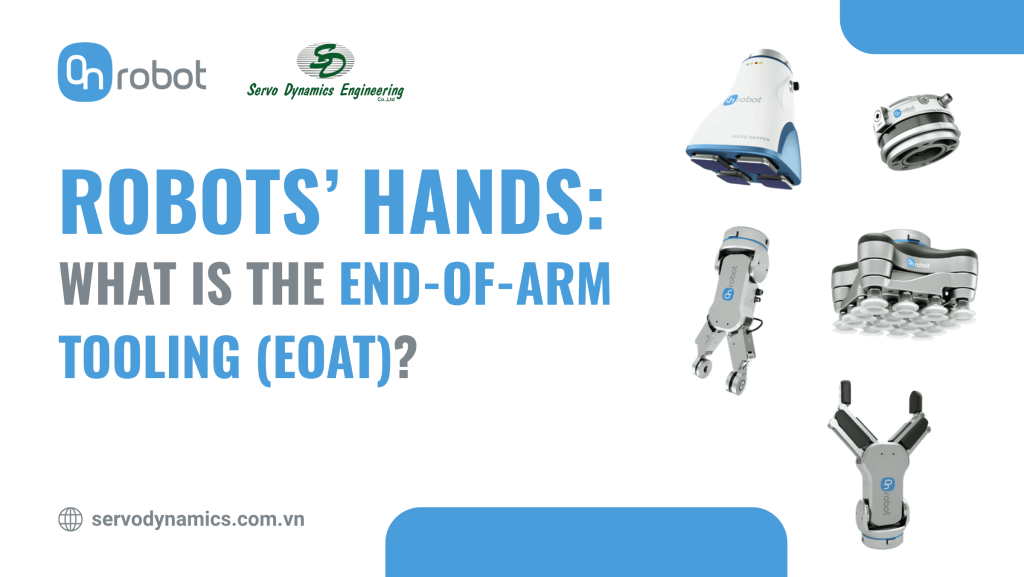
In the era of manufacturing automation, industrial robots are the shining stars. However, the element that truly unlocks the full potential of the robotic arm is the End-of-Arm Tooling (EOAT).
If the robotic arm is the muscle, then the EOAT is the precise and flexible “hand” that allows the robot to perform thousands of specialized tasks, from picking and placing, welding, and grinding, to quality inspection. This article will delve into the definition, structure, and classification of the most common EOAT types that are driving the revolution in the Smart Factory.
What is Robot End-of-Arm Tooling (EOAT)?
Definition of EOAT (End of Arm Tooling)
End-of-Arm Tooling (EOAT), also known as the End Effector, is a tool or peripheral device installed onto the final flange of an industrial robot or a collaborative robot (cobot). The core function of the EOAT is to allow the robot to directly interact with the working environment, handle materials, or perform a specific manufacturing process.
EOATs are specifically designed to execute tasks such as gripping, welding, painting, cutting, or inspecting.
How does EOAT differ from a robot tool/end effector?
In technical language, EOAT is the comprehensive term referring to all equipment mounted at the end of the robot arm.
- Tool/End Effector: This term is typically used to denote simple actuation components like a Gripper or a Vacuum Cup.
- EOAT (End of Arm Tooling): This is a broader term that includes the actuation component (Gripper/Tool) along with integrated sensor systems, mounting frames, automatic tool changers, and other control mechanisms to form a complete solution.
In other words, a gripper is a type of EOAT, but an EOAT can be a system far more complex than just a single tool.
The Role of EOAT in Manufacturing Automation
EOAT is the crucial component that determines the robot’s flexibility and application capabilities:
- Function Transformation: It transforms a general-purpose robotic arm into a specialized machine (e.g., turning a pick-and-place robot into a welding robot).
- Ensuring Precision: It allows the robot to interact with objects with absolute precision, clamping force, and repeatability.
- Boosting Cobots: For Collaborative Robots (Cobots), EOAT is an essential factor that helps them perform delicate tasks while ensuring safety and easy programming.
Basic Structure of EOAT
A complete EOAT usually consists of the following main components:
EOAT Mounting Plate
This is the mechanical interface between the end joint of the robotic arm and the EOAT body. It must be precisely designed to ensure rigidity, bearing load, and torque during high-speed robot movement.
Actuator: Pneumatic, Electric, Hydraulic
This is the power source that provides energy and controls the motion of the EOAT.
- Pneumatic: Common, low cost, fast speed, but requires an external compressed air system and generates noise.
- Electric: Precise, flexible, with adjustable force and position, easy to integrate with cobots, and represents the modern trend (e.g., electric grippers from OnRobot).
- Hydraulic: Provides the greatest force, typically used for heavy-duty applications.
Integrated Sensors
Sensors give the robot “the ability to feel,” helping the EOAT operate intelligently:
- Force/Torque Sensors: Measure the interaction force with an object, essential for delicate assembly tasks or grinding/polishing.
- Proximity/Optical Sensors: Determine the presence and position of the object/workpiece.
- Vision System: (Often a separate type of EOAT) helps the robot identify, locate, and inspect products.
Connection System to the Robotic Arm
This includes electrical cables, pneumatic lines, or hydraulic hoses, along with signal connectors for the robot to control and receive feedback from the EOAT. Quick Changer systems allow the EOAT to be swapped out in seconds, increasing the robot’s flexibility.
How EOAT Works
Principle of Transmission and Control
The operating principle of an EOAT depends on the type of actuator:
- Mechanical Grippers: The actuator (electric or pneumatic) transmits motion through gears, slides, or cams to convert rotational movement into the linear movement of the gripping fingers.
- Vacuum Grippers: A vacuum pump or Venturi system sucks air, creating negative pressure that causes the suction cup to adhere firmly to the object’s surface.
Signal and Sensor Integration
Control signals are sent from the Robot Controller to the EOAT. Conversely, sensors on the EOAT (such as force sensors, position sensors) send feedback data back to the controller. This two-way signal exchange allows the robot to perform real-time adjustments, for example: reducing the gripping force when a sensor detects a fragile object.
How EOAT interacts with the object / workpiece
The interaction between the EOAT and the object is optimized based on:
- Shape and Material: Mechanical grippers have custom fingers for rigid objects, vacuum cups for flat surfaces, or adhesive grippers for soft, light objects.
- Force: The clamping force must be sufficient to hold the object without deforming or damaging it. Force/Torque Sensors (like those used in OnRobot solutions) play a pivotal role in controlling this interaction force.
Uses of End-of-Arm Tooling (EOAT)
Increasing Speed and Production Line Throughput
EOAT enables robots to work continuously, 24/7, with faster and more consistent cycles compared to manual labor, directly increasing output.
Enhancing Precision and Repeatability
In meticulous tasks like small part assembly, spot welding, or painting, EOAT ensures every operation is repeated precisely with the same force and position, reducing the product defect rate.
Automating Hazardous and Heavy-Duty Tasks
Robots can handle jobs in harsh environments (high temperatures, toxic chemicals) or heavy, monotonous work, helping to protect workers’ health and safety.
Expanding the Application Scope of Industrial Robots
With the ability to quickly change tools, a robotic arm can switch from picking to welding, and then to grinding/polishing, expanding its application range within a confined workspace.
Classification of Popular Robot EOATs
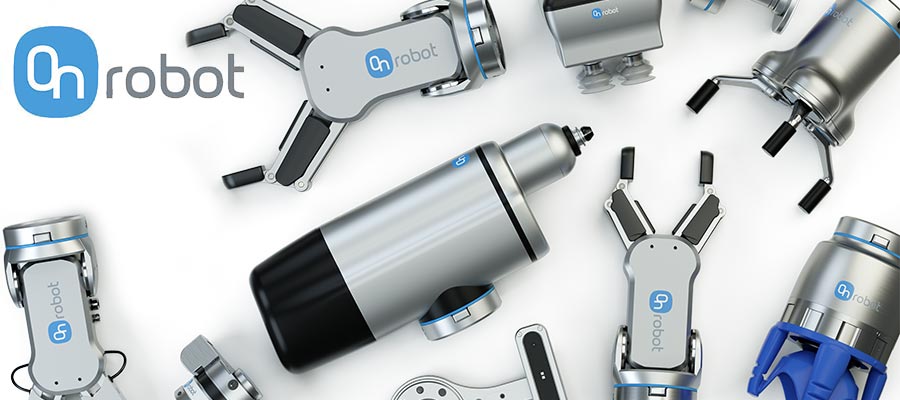
EOATs are classified based on their primary function:
Grippers
This is the most common type of EOAT, used to hold and move objects.
- Pneumatic Grippers: Air-powered, fast, simple, but with a more fixed clamping force.
- Electric Grippers: Controlled by servo motors, allowing highly accurate and flexible adjustment of force and position, easy to integrate with cobots.
- Vacuum Grippers: Use suction cups, ideal for handling flat, porous, or irregularly shaped objects, including modern electric vacuum grippers (reducing the need for compressed air).
- Adhesive Grippers: Use adhesion principles, suitable for very thin, light, or fragile materials (e.g., Gecko gripping technology).
Welding Tools
- Spot Welding: Uses large robotic welding guns to join metal sheets.
- Arc Welding: Uses a welding torch and automatic wire feeder to perform continuous welds.
Painting / Coating Tools
Spray guns are mounted on the robot to ensure uniform surface coverage, fast speed, and material savings.
Grinding / Polishing Tools
Uses grinding tools, rotating discs, or brushes for cleaning, deburring, and finishing product surfaces.
Vacuum Lifters (Suction/Lifting/Moving Material)
High-power suction cup systems used to handle heavy materials such as large cartons, boxes, metal sheets, or glass. This is essential EOAT in logistics and palletizing.
Cutting / Laser / Deburring Tools
Includes specialized cutters, laser heads, or deburring tools for precise machining tasks on products.
Inspection / Vision EOAT
Includes industrial cameras (Vision Systems) and 3D sensors, used to check product quality, locate objects, and provide feedback data to the robot.
Custom EOAT based on Production Requirements
Specifically designed for unique tasks that standard EOAT cannot meet (e.g., complex assembly EOAT, medical component handling EOAT).
Industries That Use EOAT the Most
Automotive Industry
Uses EOAT for most processes: body welding, painting, engine assembly, and component picking and placing.
Electrical and Electronics
Uses high-precision EOAT (Micro-Grippers, Vision EOAT) to pick and assemble small electronic components (chips, circuit boards).
Food and Beverage Processing
Soft Grippers or vacuum grippers are used to handle delicate foods (confectionery, fruits) in strict hygienic environments.
Packaging and Palletizing
Uses suction cups, large grippers, and palletizing systems to handle packaging, large cartons, and stack goods onto pallets.
Logistics – Palletizing
Large suction lifting systems are used to sort, lift, and move large packages in warehouses and distribution centers.
Metalworking – Precision Engineering
Uses grinding, cutting, and welding EOAT to process complex metal parts.
How to Choose the Right EOAT
Selecting the appropriate EOAT is a decisive factor for the success of an automation system.
Based on Required Gripping Force / Payload
Determine the weight of the object to be handled and calculate the necessary minimum gripping force, ensuring the force is strong enough but does not exceed the maximum payload of the robotic arm.
Based on Material and Workpiece Shape
- Rigid, block-shaped objects: 2- or 3-finger mechanical grippers.
- Objects with flat, porous surfaces: Vacuum grippers.
- Soft, fragile objects: Soft Grippers or EOAT using gentle adhesion force.
Depending on Robot Type (SCARA, 6-axis, Delta, Cobots)
- Cobots (Collaborative Robots): Prioritize electric EOAT with integrated safety sensors (like OnRobot solutions) as they are easy to program and do not require complex pneumatic systems.
- High-speed Industrial Robots: Often use pneumatic or hydraulic EOAT to achieve fast cycle times.
Requirements for Precision, Speed, and Working Environment
- High Precision: Choose electric EOAT or EOAT with integrated force/torque sensors.
- Harsh Environments: Choose EOAT with high IP standards (water and dust resistance).
Cost and Durability Factors
Consider the initial investment cost, maintenance costs (especially pneumatic/hydraulic), and the lifespan of the EOAT in the actual operating environment.
Modern EOAT Trends in Automation
Smart EOAT Integrating AI – Vision Sensors
EOATs are becoming increasingly “intelligent” by integrating 2D/3D cameras (Vision) and AI algorithms. This allows robots not only to perform tasks but also to “see,” identify objects, and adjust actions based on variations (e.g., random Pick & Place – Bin Picking).
Modular EOAT – Quick Change EOAT
Tool Changer systems allow the robot to automatically detach and attach different EOATs (from grippers to welding machines, to sensors) during the production process without human intervention, maximizing uptime. Plug-and-Play solutions from pioneering brands like OnRobot are leading this trend.
EOAT Specialized for Cobots (Safe – Flexible)
EOATs for Cobots are specifically designed to be light, safe, easy to install, and program (Plug-and-Produce), often being electric grippers with integrated force sensing capabilities, fitting the principles of safe operation in a collaborative environment.
EOAT and its Role in the Automation System
EOAT – The Robot’s “Hand” in Production
EOAT is the only tool that connects the virtual world (the robot program) with the physical world (products, workpieces). It is the final and most important point of contact, determining the translation of the programmer’s intent into actual manufacturing action.
Direct Influence on Product Quality
The quality of the EOAT (stiffness, precision of the actuator mechanism, sensitivity of the sensors) directly impacts the final result: whether the weld seam is uniform, whether the assembled part fits tightly, or whether the product is scratched during gripping.
EOAT in the Smart Factory Trend
In the Smart Factory model, sensor-integrated EOATs not only perform tasks but also collect process data (clamping force, vibration, temperature). This data is transmitted to the central system for analysis, enabling predictive maintenance, process optimization, and continuous quality assurance.
Servo Dynamics Engineering: Authorized Distributor of OnRobot in Vietnam
Servo Dynamics is also the official distributor of OnRobot – the pioneering brand in providing Plug-and-Play EOAT solutions for Cobots, including electric grippers, vacuum suction cups, and force/torque sensors.
We provide comprehensive automation solutions, from UR robotic arms to OnRobot end-of-arm tools, ensuring your business can integrate and deploy collaborative robot systems quickly, easily, and efficiently. Please contact us for specialized consultation on the most suitable EOAT solution for your production needs.
Learn More
About OnRobot OnRobot was founded in 2018 with the mission of breaking down automation barriers [...]
Wooden plantation shutter manufacturer boosts competitiveness, output, and quality with a combination of Flexiv Rizon [...]
Date : 06th Feb 2020 Venue : Shangri La’s Rasa Sayang, Penang, Malaysia. Award were [...]
Modernizing Idaho Agriculture Did you know that Idaho is not only famous for its stunning [...] 
OnRobot – Provider of End-of-Arm Tools and Accessories for Collaborative Robots
Dec

OnRobot| Slashing Sanding Time by 80% at EsVata Shutters
Dec

Servo Dynamics Vietnam Participated OnRobot APAC Annual Sales Meeting 2020
Feb

Robotic Palletizing System Tackles Labor Shortages at Magic Valley Produce
Nov