Tiếng Việt
Consulting
What is a Material Handling Robot? Definition, Working Principle, and Applications
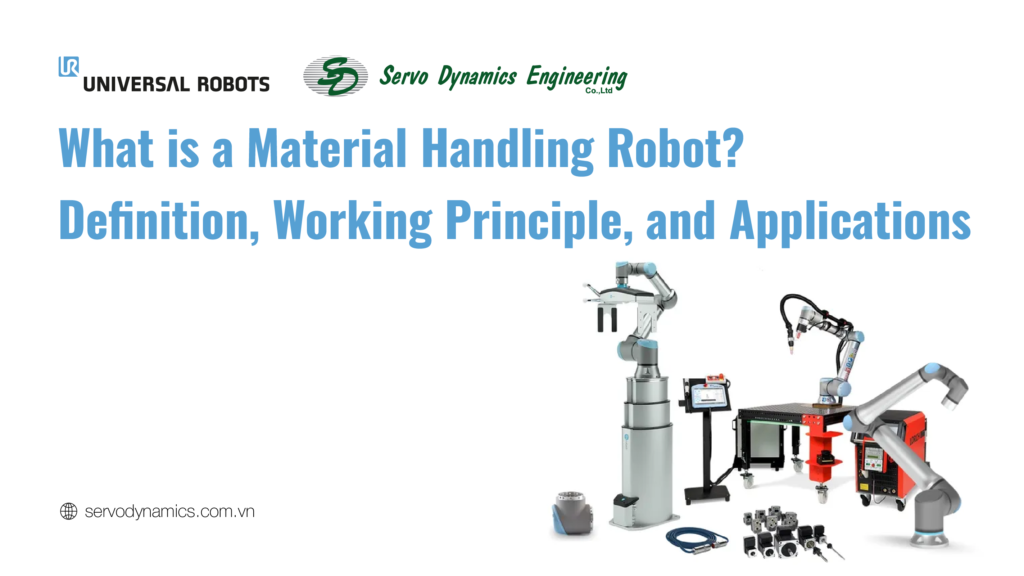
In the context of the industrial landscape shifting strongly toward full automation, optimizing material flow is a vital factor. A Material Handling Robot (Robot cấp phôi) is the key solution that helps businesses break through in productivity, ensuring stability and absolute safety in production. This article will delve into the definition, detailed structure, operating principles, and practical applications of this system.
What is a Material Handling Robot?

Concept of Material Handling Robots in Industry
A Material Handling Robot is an industrial robot system programmed to perform the movement of materials and workpieces (blanks) between production stages. The term “loading/unloading” often refers to the action of feeding raw materials into machine tools and taking out semi-finished products after the processing is complete. This is an indispensable part of Flexible Manufacturing Systems (FMS) and Smart Factories.
Basic Structure of a Material Handling Robot
A modern material handling robot system is not just a simple mechanical arm, but a complex combination of several components:
- Robot Arm: Usually 6-axis (6-DOF) robots providing maximum flexibility, allowing the gripping of workpieces from all angles and directions. The joints are driven by high-precision Servo motors.
- End-of-Arm Tooling (EoAT): Considered the “hand” of the robot. Depending on the physical properties of the workpiece, we use mechanical grippers, vacuum cups, or magnetic grippers. For fragile workpieces, the gripper may integrate soft padding or force sensors.
- Controller: Acts as the “brain,” where programs are stored, signals from sensors are processed, and the movement of the axes is coordinated. Modern controllers often support Cloud connectivity for remote monitoring.
- Vision System and Sensors: Includes proximity sensors, force sensors, and especially 2D/3D camera systems that help the robot “see” the workpiece, automatically adjusting gripping coordinates even when workpieces are cluttered on a conveyor belt.
- Robot Safety: Safety standards such as ISO 10218 regulate the installation of protective fences, light curtains, or area sensors to stop the robot immediately when a person enters a dangerous zone.
Distinguishing Material Handling Robots from Other Industrial Robots
While welding robots require extreme path precision at a stable speed, or painting robots require explosion-proof capabilities, material handling robots prioritize:
- Payload: The ability to lift objects from a few grams to hundreds of kilograms.
- Reach: The arm length must be sufficient to cover the distance between machine tools.
- Response Speed: The ability to coordinate smoothly with the speed of the production line.
Operating Principles of Material Handling Robots
Basic Operation Cycle
The operation process of a material handling robot usually follows a closed-loop cycle:
- Identification Phase: The robot receives a signal from the server or sensors that the workpiece is ready. The Vision system determines the X, Y, Z coordinates and the rotation angle R of the workpiece.
- Approach & Grip Phase: The robot moves quickly to a waiting position, then decelerates to approach the workpiece smoothly. The gripper activates to hold the object firmly.
- Movement & Loading Phase: The robot moves along an optimized trajectory to avoid physical obstacles, placing the workpiece into the fixture of a CNC machine or a waiting position on the line.
- Unloading & Repeat Phase: After the machine finishes processing, the robot receives a “Complete” signal, performs the unloading of the finished product, places it in a tray, and returns to step 1.
Automated Material Handling Robot
Uses fixed systems or guide rails (Long-track). This type is suitable for mass production where gripping and placing positions rarely change.
Autonomous Material Handling Robot (AMR)
Uses SLAM (Simultaneous Localization and Mapping) technology to build maps and move freely within the factory. AMRs often combine with a robot arm on their back to both transport and feed materials between distant areas.
Motion Control and Algorithms
- Path Planning: Uses algorithms like A* or RRT to calculate the shortest path, avoiding collisions and minimizing mechanical wear.
- Force Control: The robot has the ability to sense feedback force to grip fragile objects like electronic components or delicate products without damaging them.
- Synchronization: Deeply integrated with Manufacturing Execution Systems (MES) and industrial communication standards like OPC UA to operate synchronously with CNC machines or injection molding machines.
Popular Types of Material Handling Robots by Demand
- CNC Material Handling Robot: Usually a 6-axis robot installed next to milling/turning machines. It helps realize the concept of “Lights-out manufacturing” (production without lights or human operators).
- Loading & Unloading Robot: Specialized for metal stamping machines, where the working environment is extremely dangerous for humans.
- Palletizing Robot: Has a strong arm structure and large reach to stack boxes onto pallets according to logic standards.
- GrabIt/StackIt Systems: Plug-and-Produce solution modules that allow businesses to quickly deploy automated logistics systems without complex programming from scratch.
Practical Applications of Material Handling Robots
- Mechanical Production – CNC: Automating the feeding of steel and aluminum workpieces for lathes, mills, and laser cutters.
- Packaging Lines: Picking and placing products into trays or packing cartons in the FMCG industry.
- Logistics & Warehousing: Automatically sorting goods based on size or QR codes.
- Electronics Manufacturing: Assembling components onto circuit boards and Automated Optical Inspection (AOI).
- Automotive Industry: Feeding workpieces for car frame welding lines, engine assembly, and interior installation.
Roles and Outstanding Benefits of Implementation
- Breakthrough Productivity: Robots can work 24/7 with constant performance, helping to increase output by 30% to 50% compared to manual labor.
- Cost Reduction: Minimizes costs for recruitment, training, and long-term benefits. Optimizes factory space due to the ability to work in narrow areas.
- Consistent Quality Assurance: The repeatability error of robots is usually only plus or minus 0.02 mm, completely eliminating errors caused by fatigue or lack of human concentration.
- Improved Work Environment: Removes humans from heavy, repetitive, or high-risk safety positions.
Reputable Global Material Handling Robot Brands
Choosing the right robot brand determines 80% of the success of an automation project. Here are the leading names:
- Universal Robots (UR): The world’s number one brand for Collaborative Robots (Cobots). UR completely changes the approach to material handling:
- Absolute Flexibility: With a compact size, UR robots can be installed directly into narrow spaces next to CNC machines without changing the factory layout.
- Superior Safety: Integrates intelligent safety features, allowing robots to work alongside humans without bulky fences, saving maximum space.
- Simple Programming: An intuitive interface allows machine operators to learn and operate the robot after only a few hours of training.
- Scalability: The UR+ ecosystem provides thousands of compatible grippers and accessories, making it easy for UR robots to switch from lathe feeding to packaging or quality inspection.
- Yaskawa: A brand from Japan, famous for traditional robot lines with extremely fast movement speeds and heavy payload capabilities. This is a suitable choice for large metal workpiece handling or in large-scale automotive production lines.
- ABB: A multinational corporation famous for high stability and the RobotStudio software ecosystem. ABB is strong in 3D simulation solutions, helping businesses accurately calculate cycle times and collision risks before actual deployment.
- Fanuc: The Japanese “yellow giant” holds a large market share thanks to incredible durability. Fanuc robots are often trusted in harsh environments like foundries or stamping shops where there is a lot of dust and high temperatures.
Factors to Consider When Investing in Material Handling Robots
For an automation project to be successful, businesses need to clarify 4 questions:
- What is your workpiece like? (Weight, dry or oily surface, is the shape uniform?)
- What is the required speed? (How many products per minute?)
- What is the installation space like? (Is there enough room for the robot and safety fences?)
- Scalability? (Can the robot easily change programs to grip a different type of workpiece in the future?)
Servo Dynamics Engineering: Preferred Distributor of Universal Robots in Vietnam
Universal Robots (UR) is currently the top choice for flexible material handling solutions thanks to the collaborative robot line (e-Series). With a compact design and quick setup capability, UR helps businesses optimize initial investment costs (fast ROI).
In Vietnam, Servo Dynamics Engineering is proud to be a Preferred Distributor of Universal Robots. We do not just provide equipment; we bring total solutions:
- In-depth survey and technical consultation at the factory.
- Custom Gripper design for each type of workpiece.
- After-sales service, maintenance, and 24/7 technical support.
Are you ready to upgrade your factory? Contact Servo Dynamics Engineering today for the most modern Material Handling Robot solution!