Tiếng Việt
Consulting, Fire & Safety
Fire Alarm Annunciator: Function, Structure, and Application
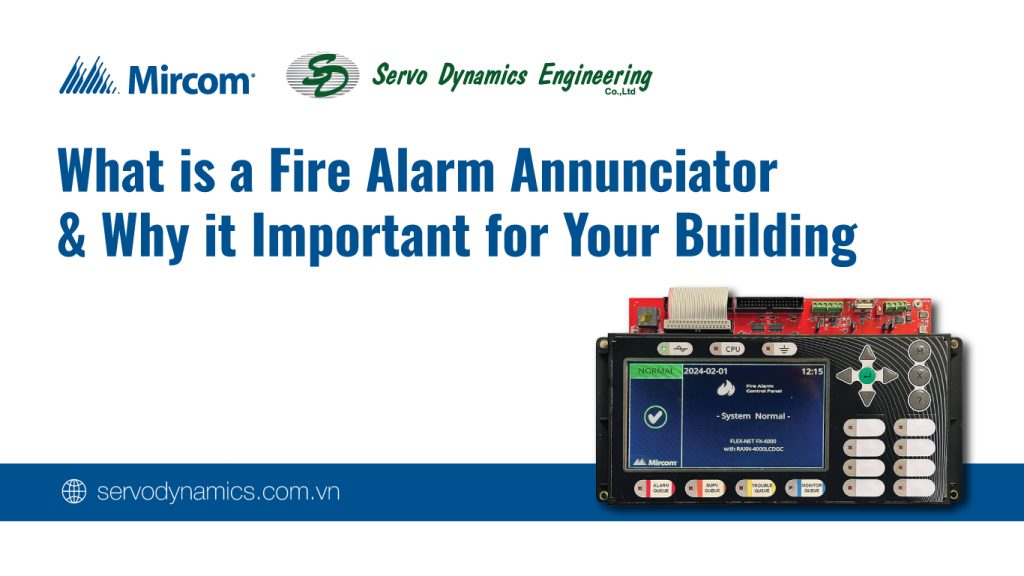
The Fire Alarm Annunciator is an indispensable component in modern fire alarm systems, especially in large-scale constructions. It acts as a “notification screen” placed at strategic locations, helping security personnel and fire forces respond quickly and accurately.
This article will delve into the structure, function, practical applications, and standards related to this critical device.
What is a Fire Alarm Annunciator?
Definition and Role of the Annunciator in Fire Alarm Systems
A Fire Alarm Annunciator is a device connected to the Fire Alarm Control Panel (FACP) to duplicate and display system status information. Instead of having to travel to the location of the main control panel, managers can remotely monitor all incidents (Fire, Fault, Supervisory).
Primary Role: Provides remote monitoring capability, helping to accurately pinpoint the location of the incident within seconds, optimizing response time in emergency situations.
Key Differences Between the Annunciator and the Fire Alarm Control Panel (FACP)
| Criteria | Fire Alarm Annunciator | Fire Alarm Control Panel (FACP) |
|---|---|---|
| Function | Displays system information and status. Can perform some basic control commands (Reset, Silence). | Processes information, supplies power, and controls the entire system (detectors, horns, lights, peripherals). |
| Installation Location | Placed in easily visible locations (main lobby, security room, guard post). | Usually placed in a central control room or technical room. |
| Independence | Cannot operate independently; must be connected to the FACP. | Operates independently; it is the “brain” of the system. |
When is an Annunciator Necessary?
Annunciators are essential for constructions with the following characteristics:
- Large Scale: High-rise buildings, industrial parks, hospitals, universities, etc., where the distance from the central control panel to other areas is very far.
- Multiple Entrances/Monitoring Locations: Requires display devices at multiple points so that security personnel on all shifts can monitor the system.
- Technical Requirements: According to Fire Prevention and Fighting standards, a monitoring point is required in the guard room or main lobby, where the central control panel cannot be placed.
Structure of the Fire Alarm Annunciator
The annunciator typically has a simple, durable structure, designed for stable 24/7 operation.
Display Screen (LCD/LED)
- LCD/Graphic Display: Common in Addressable systems, capable of displaying detailed address codes, device names, and exact locations (e.g., “Smoke Alarm P101 5th Floor – East Wing”).
- LED Display (Conventional Display): Common in Conventional systems, only displays the zone number where the incident occurred.
Status Indicator Lights (Fire, Fault, Alarm…)
LED status lights (usually yellow, red, or green) provide quick summary information:
- FIRE (Red): Signals a real fire condition.
- FAULT/TROUBLE (Yellow/Amber): Signals a technical fault (wire break, short circuit, device error).
- SUPERVISORY (Green/Yellow): Signals a supervisory condition (e.g., water valve is closed, suppression system issue).
- AC ON (Green): The system is running on grid power.
Microprocessor and Signal Receiving Module
This is the “heart” of the annunciator, responsible for receiving data from the FACP (via RS-485, CANbus, or Addressable Loop cable) and converting it into information displayed on the screen.
Function Buttons of the Annunciator
Basic function buttons help the operator manage incidents:
- ACKNOWLEDGE: Confirms the event has been recognized.
- SILENCE: Temporarily deactivates the alarm sound.
- RESET: Restarts the system after the incident has been handled.
- LAMP TEST: Checks if all LED lights are functioning normally.
Casing, Connection Ports, and Fire Resistance Standards
The casing is usually made of metal or fire-retardant ABS plastic, designed to protect internal components from environmental impacts. The device must meet certain fire resistance and durability standards (such as IP rating).
Functions of the Fire Alarm Annunciator
Displaying the Location of the Fire Area
This is the most critical function. In addressable systems, the screen accurately displays the Loop number, Device number, and detailed, pre-programmed location description.
Displaying System Errors (Fault, Trouble)
The annunciator not only warns of fire but also immediately notifies of technical faults (e.g., “Short Circuit Loop 1,” “Detector 10 7th Floor Missing”). This ensures timely maintenance, preventing system paralysis during a fire.
Supporting Remote Monitoring at Multiple Locations
In complex facilities, multiple annunciators can be installed at different points, allowing multiple people to monitor the system simultaneously, ensuring no emergency signal is missed.
Optimizing Operation and Quick Emergency Response
The ability to display detailed information allows fire safety personnel to move directly to the incident point without wasting time on location confirmation, shortening the response time and minimizing damage.
Connecting to Addressable and Conventional Fire Alarm Systems
Annunciators are designed to be compatible with both common system types:
- Conventional Systems: Display by Zone.
- Addressable Systems: Display the exact address of each device.
Mircom Annunciator and Popular Brands
Key Features of the Mircom Annunciator
Mircom is a leading global fire alarm brand from Canada, known for its advanced Networking solutions and high stability.
Typical Example: Mircom RAXN-4000LCDGC Annunciator
- Dual Functionality: Can operate as a main display screen or a Network Remote Annunciator.
- Color Graphic Display: Uses a high-resolution color LCD screen (usually 6.5 inches) with enhanced backlighting, displaying emergency information via Color-Coded Event Indication for instant situation recognition.
- Expandability: Can connect to any network node of the FleX-Net™ FX-4000N panel to monitor the entire network system.
- User-Friendly Interface: Simple menu system, navigation keypad, and multilingual support.
Comparison: Mircom, Hochiki, Notifier, Apollo, GST, Horing Lih
In the Vietnamese market, besides Mircom, the following brands are also very popular:
| Brand | Origin | Segment & Key Features |
|---|---|---|
| Mircom | Canada | High-end, specializes in large network systems, comprehensive solutions, advanced graphic displays. |
| Hochiki | Japan | Mid-to-High end, known for durability, stability, and good false alarm immunity, very popular in Vietnam. |
| Notifier | USA | High-end, smart solutions, suitable for large projects requiring international standards and deep integration capabilities. |
| Apollo | UK | High-end, focuses on smart detector technology and special fire alarm solutions. |
| GST | China | Mid-range, reasonably priced, strong development in addressable product lines. |
| Horing Lih | Taiwan | Mid-range, popular for conventional systems, easy to install and maintain. |
Choosing the Appropriate Annunciator for the Existing System
Selection must be based on the principle of synchronization:
- Brand Compatibility: The annunciator must be of the same brand and product line as the central control panel to ensure accurate and stable signal communication.
- System Type: If the FACP is Addressable, an addressable annunciator must be chosen to utilize the accurate location display capability.
- Environment: Consider dust and moisture protection standards (IP rating) if installing in workshops or wet areas.
Applications of the Fire Alarm Annunciator
Annunciators are installed in almost all types of constructions that require a professional fire alarm system.
- Apartments, High-rise Buildings: Placed on the ground floor (main lobby), basement, and security control room, helping building management staff control the fire status on different floors.
- Factories – Industrial Parks: Installed at the guard gate or guard posts to quickly identify the workshop or warehouse area experiencing the incident, allowing the internal fire brigade to quickly access the site.
- Commercial Centers – Supermarkets: Helps security staff at information desks or check-out areas know which area (store, floor) has the alarm to guide evacuation.
- Hotels – Resorts: Placed at the reception desk or night duty room, ensuring all incidents are detected and handled discreetly and quickly without affecting the guest experience.
- Hospitals – Schools: Installed in the security room, helping to accurately pinpoint the area (classroom, patient room, laboratory) with the fire alarm, thereby implementing the appropriate evacuation procedure for each group.
Connectivity Diagram and Operating Principle
Connecting to the Fire Alarm Control Panel
The annunciator connects to the central control panel via a separate data transmission line. Depending on the manufacturer, this may be an RS-485 cable, CANbus, or sometimes a direct connection to the Addressable Loop.
Loop Connection in Addressable Fire Alarm Systems
In addressable systems, the annunciator can be connected as a network device, using the proprietary communication protocol of the manufacturer to transmit all status data of the control panel.
Signal Transmission and Reception Process from Detector to Annunciator
- Detection: The fire detector (smoke, heat) detects the incident.
- Transmission to FACP: The detector transmits the signal and its address to the central control panel.
- Processing: The FACP processes the signal (classifies it as Fire, Fault, Supervisory) and activates the main horn/light.
- Display: The FACP simultaneously sends this data information via the transmission line to all connected Annunciators.
- Alert: The Annunciator receives the data and displays it using LED lights, an internal buzzer, and detailed content on the LCD screen.
Fire Alarm Wiring for Annunciators (Standards & Requirements)
According to Vietnamese PCCC regulations (referencing TCVN 5738:2021), signal cable and power supply wiring must ensure fire resistance, interference immunity, and good electrical isolation. The wiring for the annunciator is usually shielded twisted pair signal cable to ensure stable RS-485/CANbus data transmission quality, especially in industrial environments with high electromagnetic interference.
Common Faults and Troubleshooting
Annunciator Not Receiving Fire Signal
Cause: Data bus cable break between FACP and annunciator, network address setup error, or damaged communication module.
Fix: Check the continuity of the signal cable, check the communication indicator lights (TX/RX) on the module, and ensure the network address is correctly set.
Continuous Fault/Trouble Display
Cause: Power supply fault (low voltage), electromagnetic interference, or firmware/software error.
Fix: Check the 24VDC voltage supplied to the device, replace the backup battery (if available), and check the shielded cable for interference.
Faulty Fire Detector and How to Identify it on the Annunciator
The addressable annunciator will clearly state: “Trouble: Smoke Detector X, Loop Y.” If the fault is “Dirty,” cleaning is required. If the fault is “Missing” (connection loss), the wiring needs to be checked or the detector replaced.
Correct Procedure for Silencing/Resetting the Alarm
- ACKNOWLEDGE: Press this button to let the FACP know you have received the signal.
- SILENCE: Press this button to cut off the alarm sound temporarily (Should only be done after clearly identifying the incident).
- INVESTIGATE: Go to the incident location to confirm the situation.
- RESET: Only press this button after the fire incident has been completely handled.
Causes and Solutions for Fire Alarm System Errors
Most system errors (System Fault/Trouble) relate to the power supply (AC power loss, battery failure) or network communication errors. The first step is to check the power and then use the function buttons to isolate/Reset the faulty area.
Installation Standards and Regulations
To ensure system effectiveness, installation must comply with Vietnamese regulations.
Vietnamese National Standards (TCVN 5738, 3890…)
- TCVN 5738:2021: Specifies technical requirements for automatic fire alarm systems, including requirements for location, backup power capacity, and the stability of the central alarm panel and remote display/control devices.
- TCVN 3890:2009: Specifies fire prevention and fighting means for houses and constructions, regulating the location of central control panels, manual call points, and general requirements for fire safety.
Installation Location Regulations in Constructions
Annunciators must be installed at:
- Locations with 24/24 personnel (Security room, Central control room).
- Main entrances, main lobbies (Reception), or areas easily accessible to fire forces.
Distance, Height, and Wiring Requirements
- Height: Usually installed at a height that is easy to observe and operate (about 1.2m – 1.5m from the floor).
- Wiring: Must be specialized cable for Fire Prevention and Fighting (fire-resistant/heat-resistant) according to FACP and TCVN requirements.
Acceptance Testing and Verification Requirements for Fire Alarm Systems
The fire alarm system, including the annunciator, must undergo strict acceptance testing by the competent Fire Prevention and Fighting authority. The annunciator must demonstrate the ability to accurately receive and display all fire/fault signals from the central control panel.
FAQ – Frequently Asked Questions
What is the difference between an Annunciator and a Remote Control Panel?
An Annunciator is mainly for viewing information. A Remote Control Panel has a similar function but may include more control buttons and the ability to intervene deeper into the system (e.g., activating or deactivating peripherals).
Is an Annunciator needed for a small factory?
For a small factory, if the central fire alarm panel is placed in an easily visible location (e.g., near the main gate), it may not be mandatory. However, if the control panel is placed in a hidden technical room, installing an annunciator at the guard post is highly necessary to ensure timely response.
How many Annunciators can a fire alarm system support?
The number depends on the expandability of the FACP and the manufacturer’s network protocol. The Mircom FleX-Net system can support multiple annunciators per network node and can be expanded across the entire network.
Does the Annunciator work during a power outage?
Yes. The annunciator is powered by the Fire Alarm Control Panel (FACP). The FACP always has a backup power source (battery) with capacity ensuring the system operates for at least 24 hours in standby mode and 1 hour in alarm mode (according to TCVN 5738:2021).
Common Annunciator Faults and How to Handle Them
The most common faults are Communication Failure (loss of communication) due to cable break or power fault. The solution is to check the 24VDC power and the RS-485/CANbus data transmission line.
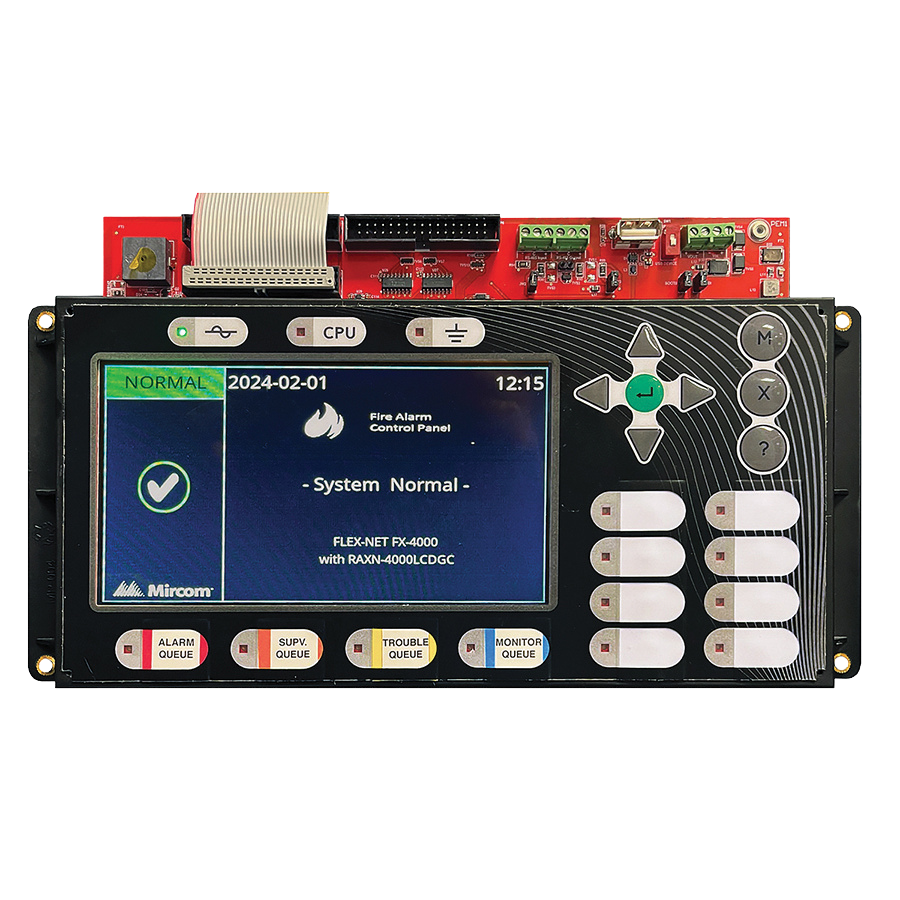
Introducing the Mircom RAXN-4000LCDGC Remote Annunciator
Need to monitor your fire alarm system from a distance? The Mircom RAXN-4000LCDGC Remote Annunciator is your solution. This powerful device is a perfect copy of your main FleX-Net FX-4000 Fire Alarm Panel display, bringing all the critical information to a remote location.
This annunciator features a large, full-color, 16-line by 40-character graphical LCD screen. This means it can display up to eight events per page with clear, two-line descriptions for each, making it incredibly easy to read and understand emergency information at a glance.
Navigating the system is simple with a user-friendly menu, a directional keypad, and dedicated buttons for Enter, Menu, Cancel, and Info. Plus, it supports multiple languages—including English, French, Arabic, and Hebrew—making it versatile for different environments. The RAXN-4000LCDGC is also expandable, allowing you to add more display modules as your needs grow.
This device is designed to fit neatly into BB-1000 or BB-5000 enclosures and is fully certified by UL and ULC, ensuring it meets the highest safety standards. For detailed technical information, you can always refer to the official documentation.
About Servo Dynamics Engineering: Authorized Distributor of Mircom in Vietnam
To ensure your fire alarm system meets the highest standards of safety and reliability, choosing a reputable supplier is a key factor.
Servo Dynamics Engineering is the Official Authorized Distributor of Mircom in Vietnam. We are committed to providing genuine Mircom fire alarm products, including advanced Annunciator lines such as the RAXN-4000LCDGC, meeting strict international standards and TCVN.
With a team of professional engineers and experience in deploying fire alarm projects nationwide, Servo Dynamics Engineering not only supplies equipment but also provides comprehensive solutions from design, installation, programming, to system maintenance, ensuring your facility is always safely protected.
Discover Mircom Products
Learn more





Fire Protection System Acceptance for Thanh Ngoc Agricultural and Food Processing Factory
In Short Servo Dynamics is proud to be a trusted partner of Thanh Ngoc in [...]
Nov

Addressable Fire Alarm System: Structure, Benefits and Operating Principle
The addressable fire alarm system is a breakthrough in fire protection technology, allowing precise identification [...]
Feb