Tiếng Việt
Consulting
What are Vision Sensors? Definition, Construction & Detailed Applications
What is a Vision Sensor?
Definition of a Vision Sensor
A Vision Sensor is an electronic device capable of converting optical images (light) into electrical signals. In the field of automation, the term Vision Sensor specifically refers to sensors that integrate both image capture and basic processing capabilities to make “OK/NG” (Pass/Fail) decisions on production lines without requiring an external computer.
In technical fields, this device is often referred to by the following terms:
- Image Sensor: Usually refers to the sensor chip itself (electronic components like CMOS, CCD).
- Vision Sensor: Usually refers to a complete device (All-in-one) including the chip, lens, lighting, and processor for industrial use.
- Photo-sensor: A general term for sensors that react to light.
In international technical documents, you will encounter the terms “Image Sensor” or “Visual Sensor.” For machine vision solutions, the term “Vision Sensor” is most commonly used to distinguish them from standard proximity or laser sensors.
Working Principle of Vision Sensors
The operation of an image sensor undergoes three complex physical and electronic stages:
- Light Acquisition: Light reflected from an object passes through a lens system and converges on the sensor surface. A microlens layer on the surface helps direct light into the precise light-sensitive positions of the pixels.
- Photoelectric Conversion: The pixels on the sensor are essentially Photodiodes. When photons strike them, they release electrons (the photoelectric effect). The number of electrons is proportional to the light intensity, creating a charge map corresponding to the actual image.
- Processing – Signal Output:
- With CCD: The electrical charge is transferred sequentially through registers for amplification outside the chip.
- With CMOS: Each pixel has its own amplification circuit; the charge is converted into voltage immediately and passes through an ADC (Analog-to-Digital Converter) to become digital data (0s and 1s).
Construction of a Vision Sensor
A modern vision sensor has an extremely complex structure with microscopic dimensions, consisting of layers stacked on top of each other:
Optical Layer Structure
The top layer is usually an array of Microlenses. The goal is to maximize Quantum Efficiency by gathering all light falling on a pixel’s area into a narrow light-sensitive region, avoiding light loss into surrounding circuits.
Color Filter Array (CFA)
To perceive colors, sensors use a color filter, most commonly the Bayer Filter (with Red, Green, and Blue – RGB cells). Without this layer, the sensor can only capture grayscale (Monochrome) images.
Photosensitive Layer (Photodiodes)
This is the silicon substrate where photons are converted into electrons. The depth and material of this layer determine sensitivity to different light wavelengths (e.g., visible light or Infrared – IR).
Signal Processing Circuitry
Consists of transistors that help amplify the tiny signals from the photodiodes, perform noise reduction, and transmit data. In modern sensors, this circuit also integrates smart image processing logic such as HDR or autofocus.
Key Parameters to Consider When Buying a Vision Sensor
- Sensor Size: Usually measured in inches (e.g., 1/1.8″, 2/3″). A larger sensor has a wider light-gathering area for each pixel, resulting in lower noise and a higher Dynamic Range.
- Resolution: Measured in Megapixels (MP). In industry, higher MP is not always better; excessively high MP can reduce processing speed and lead to smaller pixel sizes, resulting in poorer light sensitivity.
- Pixel Size: Usually measured in Micrometers (um). Large pixels (over 3 um) are suitable for low-light environments or high-speed robots.
- Frame Rate: The number of frames per second (fps). Applications like inspecting beer bottles on a conveyor belt require very high fps (over 100 fps).
- Sensitivity: The ability to react to low light intensity, usually measured in Lux.
Popular Types of Vision Sensors
CMOS (Complementary Metal-Oxide-Semiconductor) Sensors
This is the dominant technology in the market today.
- Pros: Low power consumption, integrated ADC and digital processing on-chip (System-on-Chip), very high speed, and low manufacturing cost.
- Cons: Historically prone to noise and rolling shutter effects, but modern high-end CMOS sensors now feature “Global Shutter” to completely eliminate these issues.
- Applications: Most industrial cameras, smartphones, and modern cameras.
CCD (Charge-Coupled Device) Sensors
The traditional technology based on “bucket brigade” charge transfer.
- CCD vs. CMOS: CCD offers extremely high light sensitivity and low noise, providing very clear images. However, it consumes a lot of power, generates significant heat, and is slower than CMOS.
- Status: Gradually being replaced by CMOS except for some niche applications.
CIS (Contact Image Sensor)
A CMOS variant commonly used in flatbed scanners. They are very low cost but have an extremely short Depth of Field, working only when the object is pressed against the sensor surface.
Common Sensor Sizes
| Size | Common Applications |
| 1 inch | Measurement tasks requiring extremely high precision. |
| 2/3 inch | Standard for mid-range industrial cameras. |
| 1/1.8 inch | High-quality surveillance cameras (CCTV). |
| 1/3 inch | Budget vision sensors for simple error inspection. |
Leading Global Vision Sensor Brands
Baumer (Switzerland)
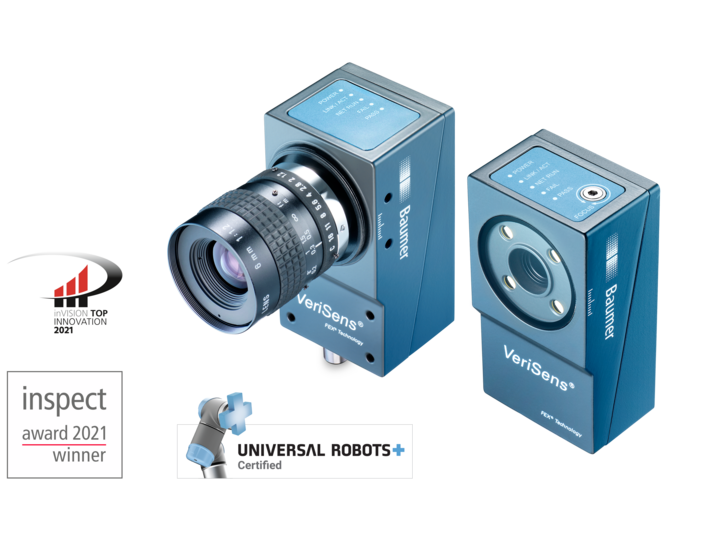
Baumer is a leading brand in precision and reliability for the harshest production environments.
- Technological Strength: Famous for its ultra-compact industrial camera series that still delivers immense performance. Baumer focuses on durability with protective housings rated up to IP67/IP69K, capable of withstanding high temperatures and strong vibrations.
- Key Highlights: Baumer sensors often integrate high-speed image processing at the edge, minimizing data latency. They are particularly known for precise real-time synchronization, making them ideal for pharmaceutical, food, and semiconductor manufacturing.
- Segment: High-end, for enterprises requiring absolute stability and long equipment lifespan.
Cognex (USA)
Known as the “king” of machine vision software and algorithms.
- Features: Cognex sells smart solutions rather than just sensors. Their Vision Sensor kits integrate powerful algorithm tools (like PatMax) that help identify objects even when they are rotated, blurred, or slightly distorted.
- Interface: Extremely smart and user-friendly, allowing users to configure settings quickly without deep expertise in image programming.
Sony (Japan)
Sony plays the role of the industry’s “roots” as the world’s largest sensor chip manufacturer.
- Features: Sony focuses on core technologies like CMOS Pregius (Global Shutter) sensors for excellent clarity. Most reputable industrial camera brands use internal components from Sony.
- Applications: Found in everything from consumer smartphones to the most advanced image analysis systems.
Keyence (Japan)
A brand that maximizes usability and on-site technical support.
- Features: Keyence vision sensors often feature an “All-in-one” design that is extremely easy to install. The brand’s greatest strength is its intuitive setup process, allowing line operators to self-calibrate in just a few simple steps.
Omron (Japan)
Its strength lies in comprehensive connectivity within the automation ecosystem.
- Features: Omron vision sensors are designed to be perfectly compatible with the brand’s PLCs and robotic systems. This helps synchronize data across the entire production line smoothly via common industrial communication standards.
Modules and Vision Sensor Kits in Machine Vision Systems
What is a Vision Sensor Module?
This is a raw component for Original Equipment Manufacturers (OEMs). It consists of a sensor chip mounted on a compact Printed Circuit Board (PCB), usually integrating MIPI or USB interfaces to transmit image data directly to a microprocessor.
Vision Sensor Kits in Machine Vision Systems
A complete Vision solution is usually an ecosystem rather than just a sensor:
- Sensor: Captures the image.
- Lens: Determines the field of view and focal length.
- Lighting: Crucial for creating contrast between defects and the product.
- Controller: Where algorithms run to make conclusions.
Real-World Industrial Applications of Vision Sensors
Applications in Automated Production Lines
- Inspection: Detecting scratches, missing bottle caps, or misaligned labels.
- Optical Character Recognition (OCR/OCV): Reading manufacturing dates, lot numbers, and QR codes for warehouse management.
- Sorting: Separating defective components or sorting parts by color/shape on a conveyor belt.
- Metrology*: Checking geometric parameters of products with extremely low error margins.
Applications in Industrial Robots (Robot Vision)
- Pick and Place: Providing object coordinates for a robot to grab items accurately, even when they are cluttered.
- Robotic Welding/Assembly: Real-time tracking of weld paths to adjust robotic arm trajectories.
- Mobile Robots (AGV/AMR): Using vision sensors for obstacle detection and navigation in warehouses.
Applications in Security and Smart Devices
Automatic Number Plate Recognition (ANPR), traffic flow monitoring, intrusion detection, and facial recognition in office buildings.
Vision Sensor vs. Industrial Camera Comparison
| Feature | Vision Sensor (All-in-one) | Industrial Camera (PC-based) |
| Construction | Integrated CPU, Lens, and Lights. | Camera body containing only the sensor. |
| Processing | Processed directly inside the device. | Transmits data to a PC for processing. |
| Complexity | Solves simple to moderate tasks. | Solves any extremely difficult task. |
| Installation | Compact, easy to set up. | Bulkier because it requires an extra PC. |
| Cost | Usually cheaper for a single station. | More expensive but very high performance. |
- When to use a Vision Sensor? When you only need to check simple tasks, like if a product has a cap or a correct label.
- When to use an Industrial Camera? When you need deep AI processing, simultaneous measurement of many parameters, or extremely high resolution (e.g., 25MP – 50MP).
How to Choose the Optimal Vision Sensor
- Define the Inspection Goal: Do you need to measure dimensions or just classify by color?
- Distance and Field of View (FOV): Is the object large or small? Is the sensor placed far or near? This determines the sensor size and lens focal length.
- Lighting Conditions: Is the environment dark or glaring? Do you need specialized lighting?
- Production Line Speed: How many products per minute does the line run? The sensor must reach a corresponding frame rate.
- System Communication: Do you need to output signals to a PLC via Ethernet/IP, Profinet, or simple Digital I/O?
Servo Dynamics Engineering: Authorized Official Distributor of Baumer in Vietnam
With many years of experience in automation, Servo Dynamics Engineering is proud to be the official distributor of Baumer and other leading Vision brands in Vietnam.
We provide:
- Genuine Baumer vision sensor products.
- On-site machine vision solution surveys and consulting.
- Technical support for programming and operating complex Vision systems.
Contact us today to upgrade the “eyes” of your factory!