Tiếng Việt
Fire & Safety
Mass Notification System (MNS): Structure, Functions, and Applications
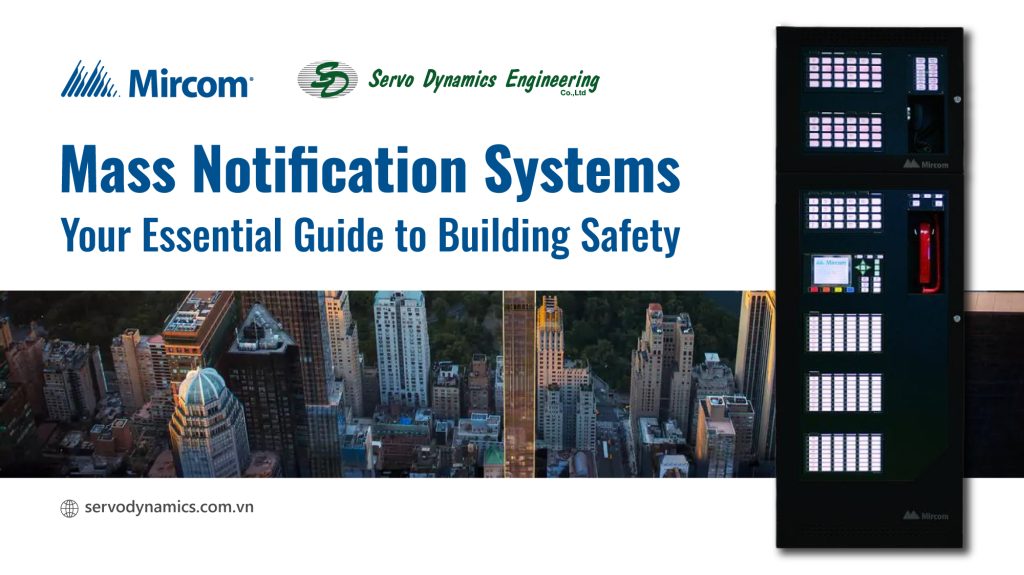
The Mass Notification System (MNS) has become an indispensable component in the safety and risk management strategies of modern organizations and enterprises. Far more than just an alarm horn, MNS is an integrated communication solution that provides real-time information and instruction to everyone within a large area.
This article delves into the structure, functions, critical standards, and practical applications of the Mass Notification System, providing readers, especially business owners, facility managers, and safety directors, with the most comprehensive overview.
What is a Mass Notification System (MNS)?
Concept of a Mass Notification System (MNS)
The Mass Notification System (MNS) is an intelligent solution designed to quickly and reliably transmit emergency messages (typically action instructions) to a large group of users or a targeted area. MNS does not rely solely on audible signals but uses multi-channel communication to ensure the message is received as effectively as possible.
MNS communicates flexibly through:
- Visual Signals: Light panels, display screens, LED signs, or flashing lights.
- Text Messages: Sent via SMS, email, mobile applications, or displayed on electronic boards.
- Audio: Loudspeakers, horns, and direct or pre-recorded voice announcements.
Purpose and Role of Mass Notification Systems in Industrial and Civil Settings
The core role of MNS is to shift from generic warnings to conveying specific and targeted action instructions.
- In Industrial Settings/Buildings: Ensures that personnel and visitors receive the safest evacuation instructions, are notified of areas to avoid, or are guided to assembly points. MNS helps prevent panic and allows the Emergency Response Team to focus their resources more effectively.
- In Civil Settings/Campuses: Provides widespread warnings about external threats (severe weather, terrorism, intrusion), giving the community enough time to react and seek shelter.
Scenarios Where Mass Notification Systems Are Used for Alerting
MNS is designed to handle a wide range of emergency situations beyond the scope of traditional fire alarms:
- Fire/Life Safety Emergencies: Fire, toxic gas leaks, emergency evacuation requests.
- Physical/Security Threats: Intrusion, active shooter, terrorism, kidnapping.
- Environmental/Weather Emergencies: Floods, storms, earthquakes, lightning strikes.
- Public Health Emergencies: Pandemics, hazardous chemical spills.
Classification of Mass Notification Systems
MNS is typically categorized based on coverage scope and level of integration:
Emergency Mass Notification Systems (EMNS)
These are specialized systems, typically using software technology to send multi-channel messages (SMS, email, applications) to a group of registered individuals. EMNS is highly effective for alerting employees, students, or residents, regardless of their location (on- or off-premise).
Fire Alarm & Mass Notification Systems
This is the integration of traditional fire alarm systems with Voice Evacuation capabilities and targeted communication. For example, an advanced voice fire alarm system like the Mircom FleX-Net Series can be configured to serve as the MNS platform within a building, complying with strict regulations such as NFPA 72, Chapter 24.
Public Address and Mass Notification (PA/MNS)
A basic PA (Public Address) system provides audio for daily announcements and background music. When upgraded to integrate emergency activation features, flexible zoning, and priority message broadcasting capabilities, it becomes a PA/MNS system, common in shopping centers and train stations.
Mass Notification Systems for Schools, Buildings, and Industrial Zones
These systems are customized according to the environment:
- Schools/Universities: Often integrate EMNS (mobile alerts) and outdoor Giant Voice speakers to warn large campuses.
- Industrial Zones/Factories: Utilize high-power horn speakers to overcome ambient noise and integrate with industrial control systems.
- Buildings: Focus on in-building voice notification and integration with Building Management Systems (BMS).
Structure of a Mass Notification System
A complete Mass Notification System comprises the following core components:
Control Unit
Also known as the Control Panel, this is the “brain” of the system. It continuously monitors the status of all devices and wiring. The Control Unit has three main states: Normal, Alarm, and Trouble (when there is a technical fault or open circuit). In integrated systems, the Fire Alarm Control Panel (like Mircom FleX-Net) often serves as the MNS Control Unit.
Trigger/Input Devices
These are the devices that initiate an alarm or activate an MNS notification.
- Smoke sensors, emergency push buttons: Trigger fire and evacuation alerts.
- Intrusion detection systems: Activate security alerts.
- Live announcement microphone: Allows operators to broadcast immediate messages.
- Other initiating devices: Heat detectors, water flow switches, valve supervision.
Communication Modules
These are the modules or protocols that help transmit messages from the Control Unit to the notification appliances.
- Wired, wireless, IP-based, VoIP: Modern MNS primarily uses IP-based protocols to transmit audio, data, and text over a network, providing higher scalability and integration capabilities.
Notification Appliances
These are the devices that emit notifications to alert occupants.
- Speakers, horns: Broadcast voice announcements or audible signals.
- LED lights, electronic signs: Display visual signals and text messages, critically important for the hearing-impaired or in noisy environments.
- NFPA 72-compliant Notification Appliances: These devices must strictly adhere to requirements for sound intensity, frequency (e.g., low frequency 520Hz to penetrate noise), and message clarity (intelligibility).
Notification Software
Allows the manager to configure emergency scenarios, zoning, store pre-recorded messages, and activate the system remotely via a computer interface or mobile application.
Key Functions of Mass Notification Systems
Rapid Transmission of Emergency Information to Multiple Target Groups
MNS provides instant broadcast capability, ensuring critical messages are transmitted to all occupants or specific target groups within seconds.
Multi-Channel Alerting
This is the superior feature of MNS. Messages are transmitted simultaneously across multiple channels to ensure maximum reach:
- Loudspeakers and voice announcements.
- SMS, email, mobile applications.
- IP speakers, visual displays.
Automated Notifications Based on Pre-Set Scenarios
The system allows for programming response scenarios (e.g., a Fire on Floor 5 automatically broadcasts message X to Floor 5 and message Y to other floors), reducing response time.
Integration with Fire Alarm and Security Systems
MNS must be capable of integrating with and overriding other non-emergency functions (like PA background music) when a fire/security alarm is triggered. This integration includes:
- Integration with automatic fire suppression systems.
- Power shutdown and elevator recall.
- Control of HVAC fans and dampers (smoke management).
- Door unlocking and releasing (evacuation function).
Reporting, Logging, and User Access Control
The system must record detailed logs of the time, type of notification, and communication channel used, serving for inspection, maintenance, and post-incident evaluation purposes.
How Mass Notification Systems Enhance Fire Safety Significantly
Mass Notification Systems (MNS) go far beyond the basic functions of a traditional fire alarm system. While conventional fire alarms focus only on signaling for evacuation, an MNS provides a more advanced, flexible, and targeted approach to fire safety communication, ensuring everyone receives the precise message at the right moment.
Clearer, Targeted Fire Safety Communication Imagine a fire breaks out. A traditional alarm might only sound a loud bell or horn. But with an MNS, you can do much more:
Specific Instructions: Instead of a generic evacuation signal, MNS can broadcast precise instructions. For example, it can direct occupants to the safest exit, announce areas to avoid, or even guide them to designated assembly points. This level of detail is impossible with a standard fire alarm system and can be life-saving. Targeted Messaging: What if the fire is contained to one wing or floor? An MNS allows you to send messages to specific areas or zones, rather than unnecessarily alarming the entire building. This helps prevent panic in unaffected areas and allows emergency responders to focus more efficiently on the affected zone. Multi-Channel Communication: Fire situations can be chaotic. An MNS ensures your message reaches everyone through various methods:
- Loudspeakers and voice announcements: Provide clear, audible instructions.
- Visual displays (strobes, LED signs, video screens): Crucially important in noisy environments or for the hearing-impaired, ensuring they receive vital fire warnings and evacuation guidance.
- Text messages and emails: Reach employees and visitors who might be off-site or in hard-to-hear locations. This channel diversity means your important fire safety message is more likely to be seen and understood by everyone.
Adaptability to Complex Fire Scenarios Fire situations are not always simple. An MNS provides the flexibility to adapt:
Flexible Instructions: In a rapidly changing fire event, initial instructions may need to be updated. An MNS allows you to broadcast new information instantly, helping occupants adjust their actions (e.g., “Do not use Stairwell A, use Stairwell B instead”). Preventing Misinformation: During a crisis, rumors can spread quickly. An MNS ensures that official, accurate information about the fire status or evacuation is directly communicated, preventing panic caused by false alarms or misinformation.
By augmenting traditional fire alarm systems with sophisticated communication capabilities, an MNS becomes an essential tool for protecting lives and property during fire emergencies. It empowers building occupants with clear, actionable information, significantly improving their chances of safety.
Integrating Voice Fire Alarm Systems with Mass Notification Voice-enabled fire alarm systems can serve as the foundation of an integrated mass notification solution. Voice fire alarm systems have the capability to instantly broadcast live or pre-recorded messages throughout buildings, campus environments, and other facilities. A common message, or separate messages tailored to specific areas, buildings, floors, or rooms, can be transmitted through the fire alarm system.
An advantage of this approach is that it is cost-effective and allows a facility to leverage existing fire and safety systems and infrastructure. Additionally, the fire alarm system provides the regulatory-mandated emergency backup capability to keep the system operational if primary power fails. It also offers a high degree of survivability, allowing networked fire alarm control panels to remain functional even if a fault or other failure occurs on the system.
Important Standards and Regulations for Mass Notification Systems
Compliance with international standards is mandatory to ensure the effectiveness and reliability of MNS.
NFPA 72 Standard – National Fire Alarm and Signaling Code
Chapter 24 of NFPA 72 (2010 edition and later) details the design, installation, and operation of MNS, especially when integrated with fire alarm systems.
- Requirements for Notification Appliances: Ensures the system’s survivability under fire conditions.
- Requirements for Volume and Notification Zone: The announcement sound must be at least 15dBA louder than the ambient noise level and must be highly intelligible in the protected area.
UL 2572 Standard – MNS Control Units
UL 2572 is the testing and certification standard for MNS Control Units. A system listed under UL 2572 ensures it has been independently tested and complies with strict technical requirements for performance and reliability.
UFC 4-021-01 Regulation – MNS Design and Operation per U.S. Military Standards
UFC 4-021-01 (Unified Facilities Criteria) is a U.S. Department of Defense standard, setting rigorous requirements for MNS in military facilities. This standard often requires MNS to integrate antiterrorism measures and focuses on two main types: Wide Area MNS (broad-range warning systems, e.g., outdoor horn speakers) and Individual Building MNS (within the building).
IPAWS – FEMA’s Integrated Public Alert and Warning System
IPAWS (Integrated Public Alert and Warning System) is a public warning system operated by FEMA (U.S. Federal Emergency Management Agency), allowing authorities to send alerts to the public via multiple mediums (radio, TV, mobile).
How does IPAWS differ from traditional MNS? Traditional MNS (like Mircom FleX-Net) is an on-premise system, focusing on warnings and evacuation instructions within a specific building or campus perimeter. IPAWS is a public system, used by the government to warn citizens over a wide area about imminent threats. A modern MNS can integrate with IPAWS to receive and rebroadcast public alerts within its own campus.
Applications of Mass Notification Systems
Factories, Industrial Parks, Production Infrastructure
Using MNS to alert about operational incidents, chemical leaks, or evacuation in high-noise production areas.
Commercial Buildings, Shopping Centers
Providing clear and targeted voice evacuation instructions, preventing panic in large crowds.
Schools, Hospitals, Residential Areas
Ensuring rapid information about security threats (lockdown) or health emergencies, protecting vulnerable populations.
Military and High-Security Areas
Deploying MNS per UFC 4-021-01 standards to warn about security and terrorism threats.
High-Occupancy Areas: Stadiums, Train Stations, Airports
Using high-power speaker systems and display screens for event management and mass evacuation.
Benefits of Implementing a Mass Notification System
Minimizing Risks and Losses
The ability for targeted communication helps minimize property damage and, more importantly, protects human lives.
Shortening Emergency Response Time
Automated scenarios and quick one-button activation help transition from incident detection to response in the shortest time possible.
Ensuring Safety for Personnel and Assets
Providing accurate information, preventing rumors and panic, helping everyone act consistently and safely.
Meeting International Compliance Requirements
Deploying MNS compliant with NFPA 72 and UL 2572 helps businesses meet strict compliance requirements, thereby enhancing reputation and insurability.
Modern Mass Notification System Development Trends
Utilizing AI for Emergency Situation Analysis
AI is integrated to analyze data from multiple sensors (cameras, IoT sensors, building management systems), helping to determine the nature of the threat and recommend or automatically activate optimal response scenarios.
IoT and Multi-Platform Connectivity
MNS increasingly leverages IoT to connect with all smart devices (wearables, personal phones, announcement screens) and expand alert coverage.
Cloud-Based Mass Notification Systems
Cloud-based MNS offers high flexibility, remote management capabilities, and rapid deployment without the need for extensive on-premise hardware infrastructure.
Integration with Building Management Systems (BMS)
Deep integration with BMS allows MNS not only to alert but also to automatically and coordinately control building functions (opening/closing doors, turning fans on/off) in an emergency.
How to Choose the Right Emergency Notification System
Define Scope and Notification Needs
Clearly determine whether you need in-building only MNS (In-Building MNS) or wide-range coverage (Wide Area MNS), and who the target recipients are (employees, customers, community).
Choose NFPA, UL Compliant Equipment
Prioritize solutions that are listed according to international standards such as UL 2572 and comply with NFPA 72 (especially Chapter 24), ensuring reliability and performance in harsh environments.
Scalability and Integration Capabilities
Select a modular and IP-based protocol system (like Mircom FleX-Net) for easy scope expansion and integration with existing security and building management systems.
Reliability and Maintenance
Requirements for power redundancy (battery backup) and continuous line monitoring mechanisms are mandatory to ensure the system is always ready to operate even if the primary power fails.
Introducing the Advanced Fire and Emergency Notification Solution: Mircom FleX-Net MNS
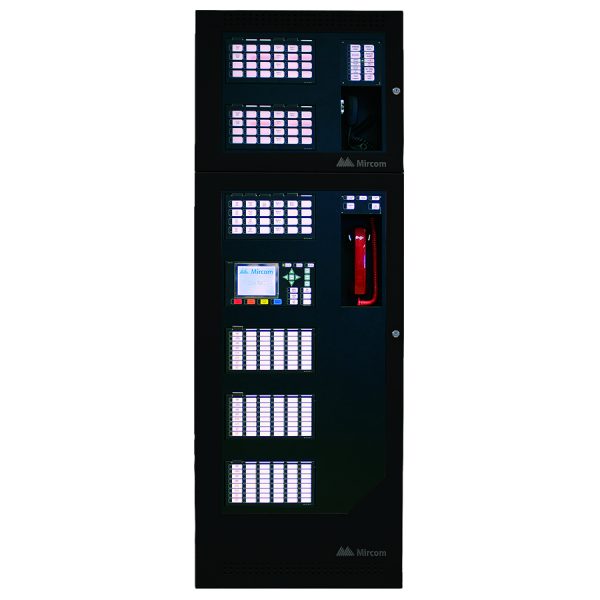
In the context of increasingly high demands for safety and emergency notification, choosing a reliable solution is paramount. The Mircom FleX-Net MNS is the “next-generation” modular network system, specifically designed to meet the most stringent requirements in fire protection and emergency communication.
FleX-Net MNS delivers superior flexible system configuration, with various cabinet options and sizes for control and signaling. Thanks to its modular design, the system provides nearly limitless freedom to establish local, group, or global control and notification wherever needed. Notably, you can configure up to 7 LCD display/control frames in a single node, optimizing monitoring and operational capability.
The Mircom FleX-Net Series is a powerful intelligent fire alarm solution, capable of networking with multiple levels of flexibility, meeting almost every application from detection, control, notification, to emergency communication. Key features such as fire detection & alarm, audio/voice evacuation, BACnet, Boolean logic, networking capability, and graphic workstations, allow this modular solution to suit everything from the simplest systems to the most complex solutions.
With the addition of Advanced Protocol (AP), fire/CO detection capability, and 520 Hz frequency support on both addressable loops and through the audio/voice evacuation system, Mircom FleX-Net MNS is ready to take you further into the future with superior expansion capabilities. The system supports multiple intelligent protocols such as MIX-4000 Devices, Advanced Protocol (AP), and Classic Loop Interface Protocol (CLIP).
FleX-Net MNS stands out with key features such as:
- Real-time information delivery: Ensures the provision of immediate, up-to-date information during emergencies, helping occupants be fully informed and react appropriately.
- Flexible response: The system automatically adjusts as the emergency situation changes, ensuring the most relevant information is always communicated.
- Advanced hardware and software: Utilizes the latest industry technology to provide reliable, clear audible and visual notifications, live voice guidance, and text messages over the internet.
- Integration capability: Can be easily integrated with other public safety systems for comprehensive emergency communication across wide area networks.
- Standards compliance: Listed under UL 2572 for Mass Notification Systems and complies with NFPA 72-2019 and UFC/DOD standards for emergency communication systems. The system is also UL Listed for Smoke Control (UUKL).
- Storage and activation of pre-programmed messages: Allows for quick, efficient communication during emergencies.
- One-way and two-way EVACS capability: Supports both outbound emergency communication and receiving feedback or requests for assistance.
- Synchronized evacuation zone signals: Ensures all areas of the building receive emergency notifications simultaneously.
- Large LCD screen: Provides clear, easy-to-read information and instructions during emergencies.
- Remote diagnostics: Built-in web server and standard Ethernet port in each node allow for remote monitoring and troubleshooting.
- Supports over 250,000 points on a single network: Ensures comprehensive coverage even for the largest facilities.
Additionally, QAA series amplifiers have been listed as compatible for 520Hz low-frequency operation with select System Sensor and Gentex speakers and speaker/strobes, ensuring optimal effectiveness in message delivery.
Servo Dynamics Engineering: Authorized Distributor of Mircom in Vietnam
To ensure that our customers in Vietnam can access and effectively deploy the leading Mass Notification System solutions, especially the advanced modular network system Mircom FleX-Net MNS, Servo Dynamics Engineering is proud to be the official authorized distributor of Mircom in the Vietnamese market.
Mircom FleX-Net MNS is the “next-generation” networked fire alarm and emergency communication solution, highlighted by:
- Standards Compliance: Listed under UL 2572 and compliant with NFPA 72-2019 and UFC/DOD.
- Flexible Response: Ability to store and activate pre-programmed messages, allowing for quick, effective communication during emergencies.
- Superior Scalability: Supports over 250,000 points on a single network, suitable for the largest facilities and campuses.
With extensive professional experience, Servo Dynamics Engineering is committed to providing high-quality, genuine products from Mircom, along with professional consulting, installation, and technical support services, ensuring maximum safety for your personnel and assets