Tiếng Việt
News, Solutions, Stratus Technologies
Difference Between Cloud, Edge, and Fog Computing
Is fog a cloud?, fog vs cloud, cloud vs edge. Still a lot of questions around these computing areas. With the ever-evolving technology landscape, it can be hard to keep up with new terminology and capabilities. Most people have a good handle on “The Cloud” and what it can do, but newer terms like edge computing or fog computing aren’t as well understood, even though they are helping drive innovation in many areas. So we wanted to help define these three terms and show how they are being used to power IIoT architectures.
What is Cloud Computing?
To break it down to the simplest terms, cloud computing means that data is processed and accessed via the Internet, rather than on a hard drive or local server. For businesses, cloud computing reduces cost through metered services and the ability to scale as needed to meet demand. It also allows employees to access documents from wherever they happen to be, as long as they have network access via the Internet. It also enables consumer applications like mobile banking and streaming entertainment. Some drawbacks of cloud computing include latency and limitations in real-time processing.
Benefits of cloud computing
In the past, organizations typically owned, managed, and operated information systems in-house. With cloud computing, a company doesn’t have its own system, but can use the system via the Internet. Users can leverage these services and applications from anywhere.
The cloud has become popular due to its low initial cost, ease of system expansion according to needs, and high convenience. Below we’ll take a closer look at the benefits of cloud computing.
- No time or place restrictions
With cloud computing, services and applications can be used from anywhere as long as there is a terminal – with sufficient performance – that is connected to the Internet. As there are no restrictions on time or place, the range of usage patterns expands and the degree of freedom in providing services increases.
- Highly scalable
A major advantage of cloud computing is the ability to expand the system as needed. Even if a company needs more resources than they currently have, they don’t have to set up an in-house computing environment. An organization can expand resources as needed. It can also be scaled down if demand declines.
- Effective utilization of hardware resources
Cloud computing also benefits service providers. Multiple users share the same hardware, maximizing resource utilization and making the most of the computing environment they provide.
- Improved cost efficiency
Without overspending, users can leverage the resources they need, when they need them. Costs can be changed in response to demand fluctuations and companies can reduce fixed costs, improving financial stability. Essentially, the initial investment can be suppressed because there is no hardware purchase cost.
- Easy access to latest technology
Cloud service providers have large data centers and can rapidly deploy the latest hardware and software. Cloud providers are more likely to adopt the latest technology, which means consumers can stay on top of the latest technology as well.
Challenges with using cloud computing
Amid the benefits listed above, the use of cloud computing also poses new challenges, including:
- Network connection requirement
To use resources on the cloud, you must be connected to the Internet. If there is a problem or trouble with the network, there is a risk that the entire system will not be available and business operations will stop.
- Security risks depend on cloud servers
As critical data is stored on cloud servers, countermeasures against external cyberattacks will depend on the security of those cloud servers. If there is a security breach, all the data could be leaked.
- Delays due to increased traffic
Cloud computing often involves frequent client-side communication. In addition, the amount of data to be sent and received is enormous because various processes are performed on the cloud server. When such data transmission and reception are concentrated, data congestion – or delay due to increased communication traffic – occurs. For systems that require continuous operations or real-time processing, the impact is even greater.
What is Edge Computing?
Edge Computing is a distributed computing model that collects data at the edge of the network, like on a plant floor, and processes that data in real time. The benefits of edge computing include reduced bandwidth use, which saves money and avoids bottlenecks, increased security via encryption at source, and optimizing data performance by dividing workloads between the edge and the cloud. Edge computing addresses the drawbacks of the cloud by reducing latency.
Advantages of Edge Computing
Edge Computing produces a variety of benefits through distributed processing. Among them, there are many elements that solve the challenges of cloud computing. Let’s take a look at the benefits Edge Computing brings:
- Less delay and improved real-time performance
In cloud computing, a time lag of several hundred milliseconds to several seconds occurs due to sending and receiving data to and from distant cloud servers. With Edge Computing, processing that needs to avoid delays can be managed on a nearby computer, making it possible to process data without delay. This ensures the real-time nature of data utilization.
- Improved security through distributed storage of data
Security risks, information leaks, and external attacks are always a concern when storing corporate and personal information in the cloud. However, with Edge Computing, the risk of a data breach is reduced because data is processed on the edge side and stored in a distributed manner at the edge and in the cloud.
- Communication traffic optimization
Edge Computing processes all data at the edge without aggregating it to the cloud. This can reduce communication volume and optimize communication traffic. Traffic is less likely to be delayed when it needs to be sent to or received from the cloud. Additionally, organizations can cut communication costs by reducing the amount of data sent to the cloud and the amount of communication.
- Business continuity when network trouble occurs
When all data is operated on the cloud, it can be difficult to reliably carry out business that requires data amid cloud service failures or network troubles. If the necessary data is processed on the edge side by an Edge Computing platform, it is possible to continue business even if network trouble occurs. Edge Computing is therefore also a measure for business continuity planning (BCP).
Challenges with using Edge Computing
While there are various benefits, there are some challenges in optimizing the use of Edge Computing, such as:
- System complexity and cost
Edge Computing requires as many edge servers as there are lines and bases. Therefore, the number of hardware increases and the system can become complicated. As hardware is required for the number of lines and bases, the initial cost and system development cost will increase.
- Securing human resources and training costs
As Edge Computing is often distributed in each location, it is sometimes not possible for one person to centrally manage many multiple terminals, especially if something goes wrong on a manufacturing plant floor, for example, and there is limited IT expertise. As a result, the cost of training personnel tends to increase. Securing on-site personnel can be the biggest issue in Edge Computing operations, which is why selecting a simple, protected, and autonomous Edge Computing platform is essential.
- Data storage capacity
Typically, edge computers, such as industrial PCs, do not have a large memory capacity. Because of this, it’s not possible to store all data forever. The data used for analysis is often deleted after a certain period of time or after the analysis results have been sent to the cloud server. It is necessary to select which data to keep and which data to store at the edge and in the cloud.
What is Fog Computing?
Fog computing may seem very similar to edge computing because both involve moving processing closer to where data is collected. But in fog computing, data is transmitted from the point of collection to a gateway for processing, then sent back to the edge for action. Fog computing uses edge devices and gateways with a LAN for the processing. Combining the ability to run applications at the edge in concert with the capacity of the cloud, fog computing acts as a bridge, bringing together the cloud and the edge.
Advantages of Fog Computing
- Lower Latency than Cloud:
By processing data closer to the edge than the cloud, fog computing reduces latency for applications that require near real-time responses.
- Reduced Bandwidth Usage:
Fog nodes can filter and pre-process data before sending it to the cloud, reducing the amount of data transmitted.
- Improved Scalability and Management Compared to Edge:
Fog infrastructure can handle more complex tasks and is often easier to manage than a large number of individual edge devices.
- Enhanced Reliability:
Provides a degree of redundancy and can continue operating even if some fog nodes or the cloud connection are temporarily unavailable.
- Supports Heterogeneous Devices:
Can connect and process data from a wider range of edge devices with different capabilities.
Challenges with using Fog Computing
- Increased Complexity:
Introducing a fog layer adds complexity to the overall system architecture.
- Security Challenges:
Securing the distributed fog layer requires careful planning and implementation.
- Management Overhead:
Managing a distributed fog infrastructure can be more complex than managing a centralized cloud.
- Potential for Data Silos:
Data processed and stored in different fog nodes might need careful integration.
- Overlapping Functionality with Edge and Cloud:
The distinction between edge, fog, and cloud can sometimes be blurry, leading to confusion in implementation.
Cloud vs. Edge vs. Fog Computing: A Comparative Table
| Feature | Cloud Computing | Edge Computing | Fog Computing |
| What is it? | Centralized data processing and access via the Internet. | Distributed processing at the source of data generation. |
Extends cloud closer to the edge, using network infrastructure.
|
| Data Processing | Primarily in large, remote data centers. | Locally on devices or near the data source. |
In between edge and cloud, often on network gateways.
|
| Latency | Higher latency due to network travel. | Very low latency, enabling real-time responses. |
Lower latency than cloud, near real-time capabilities.
|
| Bandwidth Usage | High bandwidth usage for data transmission. | Reduced bandwidth by local processing. |
Reduced bandwidth by pre-processing and filtering.
|
| Scalability | Highly scalable and elastic on demand. | Limited scalability per edge device. |
More scalable than edge, less than cloud.
|
| Management | Centralized management by cloud providers. | Distributed management can be complex. |
More manageable than many individual edge devices.
|
| Security | Security relies on cloud provider measures. | Enhanced security through distributed storage and local encryption. |
Requires careful planning for distributed security.
|
| Cost | Low initial cost, pay-as-you-go model. | Higher upfront investment in edge hardware. |
Adds complexity and potential cost for infrastructure.
|
| Network Dependence | Requires a reliable internet connection. | Can operate independently during network outages. |
More resilient to network issues than direct cloud.
|
| Real-time Processing | Limitations due to latency. | Excellent for real-time processing and decision-making. |
Good for near real-time processing.
|
| Data Storage | Centralized storage in the cloud. | Distributed storage at the edge and potentially cloud. |
Distributed storage in fog nodes and potentially cloud.
|
| Complexity | Relatively simple for users. | Can be complex to deploy and manage. |
Adds complexity to the overall architecture.
|
| Use Cases | Web applications, data analytics, storage, SaaS. | Industrial automation, autonomous vehicles, IoT sensors requiring immediate action. |
Smart cities, connected vehicles, localized analytics and control.
|
| Relationship | Central hub for data storage and advanced analytics. | First point of data interaction and immediate action. |
Acts as a bridge, aggregating and processing data between edge and cloud.
|
How Cloud, Edge, and Fog Work Together
Companies have choices about how to implement cloud, edge and fog technologies to best support their needs. To figure out which technology is best suited to the task, workloads should to be categorized into categories like monitoring, analyzing, and execution. Once these are defined, it will dictate the best network structure. It’s a question of the right data in the right place at the right time.
An example of the role of each server in a three-tier model
Finally, let’s review the role of each server in the three-tier model:
First, the role of the edge server is to collect data and respond to emergencies. Emergency response is, for example, a temporary emergency stop of a robot when it is likely to hit a person. Edge servers are basically faster in terms of being closer to where the data is generated, so edge computing is probably the most suitable for urgent processing. Therefore, artificial intelligence (AI) used in applications such as predictive maintenance will basically be placed on the edge server because of the demand for speed.
The role of the fog server is to store and analyze data and send the results to the cloud. In some cases, the fog server may collect data directly or act as a cloud server on your behalf. In the artificial intelligence example given above, it could be placed on a fog server for applications where response speed is not required.
The cloud server is responsible for managing the data from the edge server and fog server, displaying it to the person in charge, and sending the analysis results to a higher-level system (for example, a business management system). Also, in edge computing, cloud servers will often store and analyze data.
Source: https://blog.stratus.com/
Edge Computing Solutions
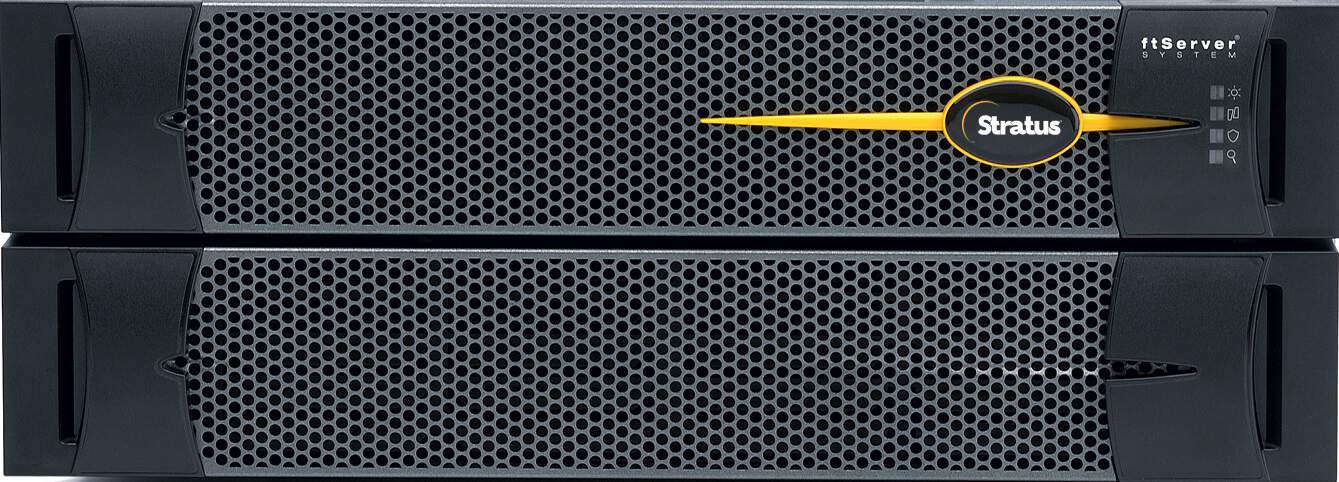
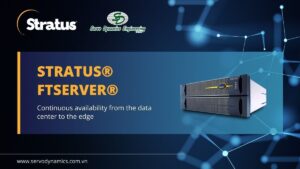
Optimized for Edge Computing, Stratus ftServer delivers the performance needed to support your advanced processor and data intensive applications, while also providing the fault tolerance, security and manageability required at the edge of your corporate networks.
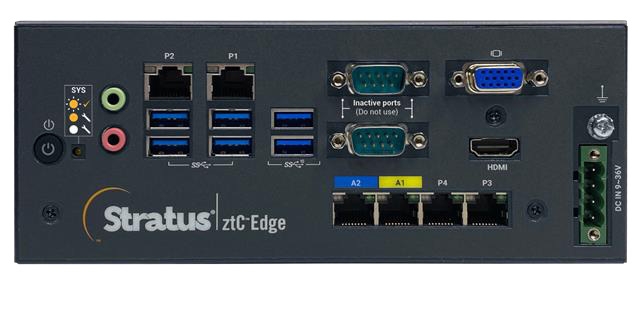
Stratus’ newest solution, ztC Edge, was specifically designed for the edge. Stratus ztC Edge is a secure, rugged, highly automated computing platform that delivers business-critical industrial applications quickly, reliably, and efficiently, even in decentralized, understaffed locations.
Servo Dynamics – A Master Distributor of Stratus in Viet Nam
Servo Dynamics, as the authorized master distributor of Stratus Technologies in Vietnam, offering the cutting-edge, fault-tolerant edge computing solutions from Stratus to local businesses. With a focus on ensuring continuous availability, seamless integration, and real-time data processing, Servo Dynamics ensures businesses in Vietnam access to some of the most advanced technologies available today, including ztC Edge and ftServer.
Servo Dynamics is committed to supporting local industries through expert guidance, seamless deployment, and continuous support, ensuring that businesses in Vietnam can leverage the power of Stratus technology to thrive in today’s fast-paced, data-driven world.
Edge Computing is transforming the way businesses process data by decentralizing computing and bringing processing [...]
Stratus Technologies Industry Applications Midstream Oil and Gas What are the Midstream Challenges? Scalability, Extensibility [...]
In today’s fast-paced business world, ensuring the continuous availability of critical applications and data integrity [...] Learn more
Edge Computing: What it is, Benefits, and How it Compares to Cloud
Nov

Stratus Vietnam – Servo Dynamics Engineering As Authorized Distributor
Oct
Stratus ftServer: Features, Benefits, Models, and Applications
Nov