Tiếng Việt
Consulting
Applications of Cobots (Collaborative Robots) in the Food and Beverage (F&B) Manufacturing Industry
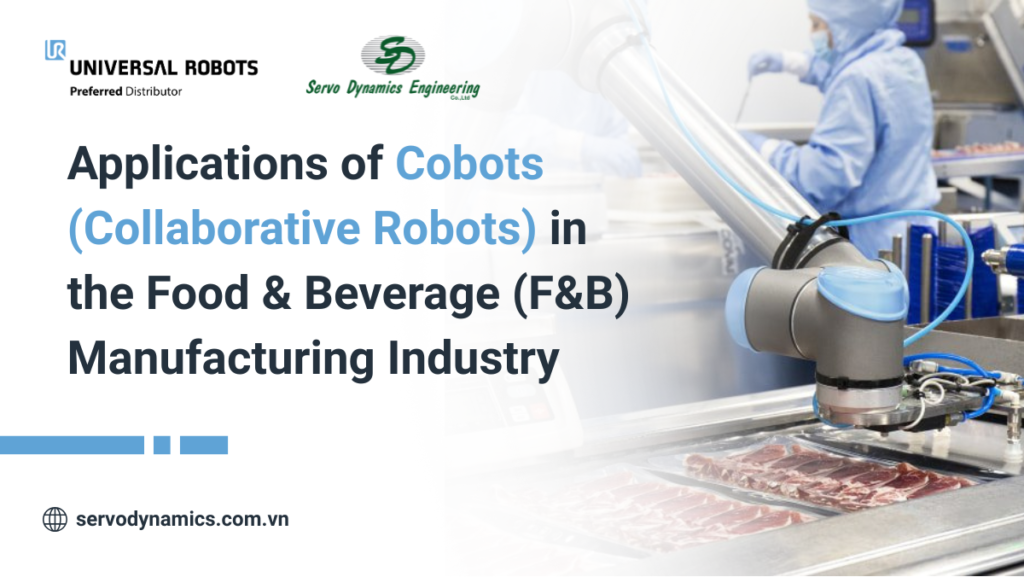
Why does the food manufacturing industry need collaborative robots?
What are collaborative robots?
Collaborative robots, also known as a collaborative robot arms or cobots, are programmable mechanical devices that mimic the function and flexibility of a human arm to perform a range of tasks in a workspace.
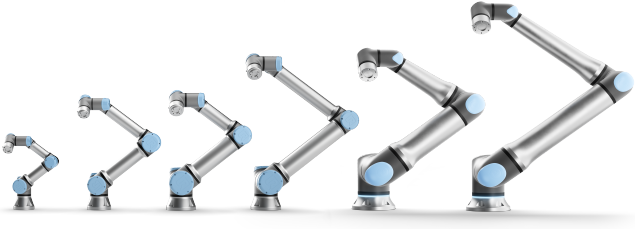
Collaborative Robot Models of Universal Robots
Common problems in the food manufacturing industry:
With increasing product demand, the food manufacturing industry needs to expand its operations, with more stable and faster production lines, ensuring food safety and hygiene. This necessitates a comprehensive reassessment of operational capabilities, especially as older production lines reveal limitations when changing SKUs:
- Labor shortages lead to reduced production speed.
- Highly repetitive and heavy workload, causing workplace injuries, reducing efficiency, and leading to human errors.
- Food safety and hygiene requirements are becoming increasingly stringent, demanding consistency throughout the production line.
- Lack of flexibility between different processes and products, due to the need for buffer time to replace machinery, prototypes, or product sizes.
- High demand for finished products at high speed: major bottlenecks are processing capacity and human error.
- Some specific environments, such as high-temperature processing areas or cold storage, require occupational safety measures or are not entirely suitable for direct human labor.
Economic and Operational Consequences of Problems in the Food Manufacturing Industry:
- Reduced production chain efficiency: labor shortages and human error slow down the production line, increasing product creation time;
- Increased labor costs to ensure output: workers have to work overtime to compensate for production, especially during peak production seasons;
- Increased raw material costs: substandard food products cannot be reused, leading to resource waste;
- Increased food safety and hygiene costs: Increased consumption of chemicals, hot water, and steam for CIP (Cleaning In Place) to clean processing areas and production lines;
- Impact on OEE: time lost to adjust for different products, resulting in lost output;
- Increased production cost per unit (Cost per Unit), reducing profit margins and potentially causing a loss of competitiveness with rivals.
Benefits of intergrating Cobots in F&B production:
- Quick installation and setup: cobots can be easily deployed into existing production lines, easily reprogrammed when SKUs change;
- Safe and reliable operation: reduces accidents and injuries in processing environments or loading/unloading areas;
- Continuous operation for extended periods: reduces downtime, maintains stable production speed throughout the shift;
- Increased product consistency: improves quality and reduces production waste;
- Enhanced food safety and hygiene: easy to trace the source of contamination in case of incidents, preventing cross-contamination
Main applications of Cobots in the F&B industry:
- Palletizing: the process of a robot lifting boxes, trays, or bags from the production line and stacking them onto a pallet according to a pre-designed pattern.
- Pick & Place: the operation of a robot picking a product from position A and placing it in position B with high speed and accuracy.
- Packaging: This is the process of robots placing products into trays, boxes, bags, or cartons, depending on the type of packaging.
- Inspection: Inspection involves robots checking the appearance or quality of products and removing defective products from the production line.
Ứng dụng cánh tay robot trong Palletizing ở ngành F&B
Application of Cobots in Palletizing in the F&B Industry
How Cobots function in Palletizing
- Receive cartons from the production line
- Determine position using sensors/vision (if needed)
- Pick-up using a clamp/suction gripper
- Place onto the pallet according to a predefined pattern
- Repeat until the required layer or pallet is filled
Benefits of using Cobots for palletizing
- Increased productivity and accuracy when stacking pallets in confined spaces
Robots can operate continuously 24/7 at a stable speed, achieving productivity of 10–50 products/minute depending on the model. Thanks to near-perfect accuracy, pallets are always stacked straight, securely, and uniformly, optimizing transportation and storage processes.
- Reduced Labor Costs and Reduced Packaging Damage
Cost Savings: Cobots replace many strenuous labor positions, helping businesses reduce costs for salaries, insurance, and personnel management.
Reduced Errors: Automated processes completely eliminate human errors such as incorrect stacking, insufficient packing, or damaging products during handling.
- Improved Workplace Safety and Reduced Risks
Cobots handle heavy and repetitive tasks (lifting/lowering heavy objects over 20 kg), reducing common injuries such as back pain and muscle strain.
- Optimized Space and Improved Line Efficiency
Cobots palletizing systems have a more compact and flexible design compared to traditional palletizing machines. Their fast and stable operation avoids bottlenecks at the final stage, thereby improving the overall efficiency (OEE) of the production line.
Types of Palletizing Applications in F&B
Universal Robotics’ robotic arm is used in the palletizing stage of cake boxes.
Carton Palletizing
Used for bottled water, milk, beverages, packaged food… Cobots stack cartons quickly and evenly, compatible with most standard packaging lines.
Bag palletizing
Suitable for bags of flour, sugar, rice, animal feed, etc. Cobots can lift and place heavy bags stably, reducing deformation and preventing bag tearing.
Mixed palletizing (multiple SKUs on one pallet)
- Suitable for F&B distribution centers
- Cobot combined with vision to identify SKUs
- Flexible creation of mixed pallets that traditional robots struggle to optimize
Depalletizing
Robot arms can be used to remove boxes or bags for delivery to the production line or sorting. Common applications in F&B raw material warehouses, helping to:
- Automate the input material picking process
- Increase the loading speed for processing lines
- Reduce injuries when lifting heavy containers from shoulder/head height
Application of Cobots in the Pick & Place step in the F&B industry
Benefits of using Cobots for the Pick & Place process:
- Increased productivity and stable speed maintenance
Cobots can perform pick & place operations continuously at a stable speed, unaffected by fatigue or manual errors. This helps processing and packaging lines maintain optimal production rhythm, especially during night shifts or high production volumes.
- Ensure hygiene and food safety for export goods
Cobots minimize direct contact between human hands and food, reducing cross-contamination and complying with HACCP/GMP standards, resulting in safer and more exportable products.
- Flexible handling of diverse products, including soft foods
Cobots can handle a variety of food types without damaging them—something traditional industrial robots struggle to achieve.
- Easy integration and suitability for small spaces
Cobots are small, require no protective barriers, and can be easily integrated into existing production lines without major modifications. This is especially useful in F&B factories that often have limited processing space.
Pick & Place applications in Processing
- Loading ingredients into processing machines
Robots can feed meat, fish, and vegetables into equipment such as cutters, mixers, and blenders with high precision. Reducing human contact not only increases product consistency but also meets stringent hygiene standards in food production.
- Material Transfer Between Stages
Robots continuously move materials from the washing machine → cutting machine → mixing machine → packaging machine, maintaining a stable production pace and minimizing waiting time between steps. As a result, the production line always operates smoothly and achieves higher productivity.
- Picking & Buffering Semi-Finished Products
Robots automatically transfer semi-finished products through each subsequent processing step. This prevents production flow disruptions and helps businesses optimize speed and responsiveness during the processing stage.
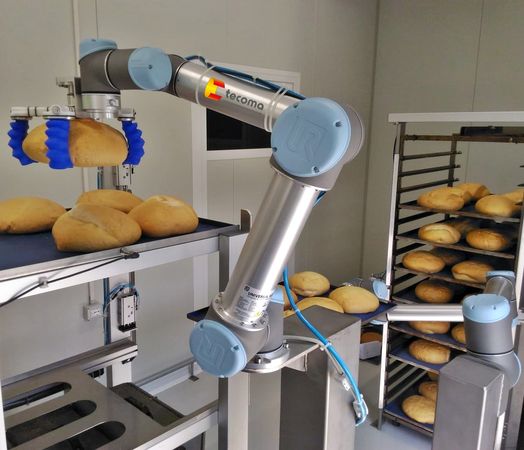
The cobot stacks the finished bread products onto the next assembly line.
Pick & Place Application in Portioning
Pick & Place robots automate the portioning process in the F&B industry, ensuring each serving meets the correct quantity and weight standards.
- Weight-Based / Count-Based Food Portioning
Robots can accurately pick the required quantity of products or combine them with electronic scales. This helps reduce weight discrepancies, minimize material waste, and ensure product consistency.
- Arranging food in trays according to a fixed layout
Robots arrange products according to a predefined layout, making each tray aesthetically pleasing, uniform, and compliant with retail standards or production line standards.
- Separating irregularly shaped products
For irregularly shaped foods, the vision system identifies the shape and size of each piece so the robot can select the optimal picking location.
Application of Cobots in packaging in the F&B industry
Benefits of Cobots in the packaging process:
- Integrating vision systems for product identification and inspection
Cobots in packaging stage are often combined with industrial cameras (machine vision) to improve accuracy and completely eliminate human eye recognition errors.
- Vision for Orientation Checking
Before picking or packing, to ensure the product is placed correctly and optimizes the stacking area. Cobots have the ability to control force and movement trajectory precisely, thereby:
- Maintaining consistent and stable picking force throughout the production shift
- Preventing distortion, compression, or breakage of soft products
- Reducing packaging damage due to rough handling or misalignment
Before picking or packing, to ensure the product is positioned correctly and the packaging space is optimized, Vision determines:
- Top/bottom of the product
- Correct rotation angle of the product
- Precise position on the conveyor belt: Cobots can readjust orientation in real time, ensuring correct stacking.
- Vision supports packaging multiple types in one box
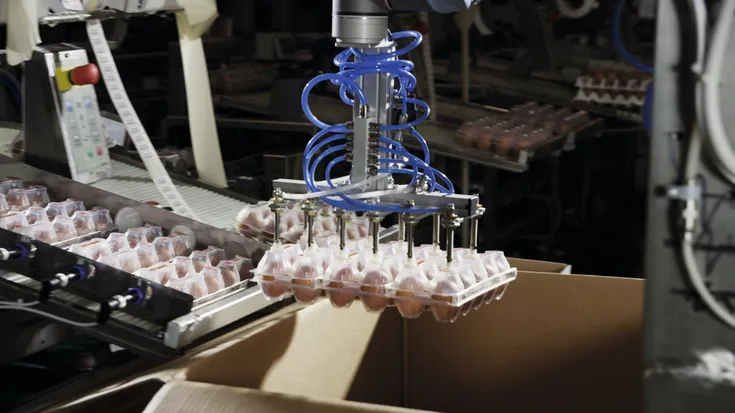
Universal Robots’ cobots assist in the secondary packaging stage of egg products.
Common Packaging Applications of Robots in F&B
Robots play a central role in the automation of the food industry’s packaging process, from handling loose products to packing and palletizing. Depending on the packaging level, robots can perform various tasks to increase speed, reduce errors, and improve the stability of the production line.
Primary Packaging
The first stage in packaging, where cobots directly perform actions on each individual product.
- Picking products into trays/containers: Cobots can:
- Use vision to accurately position products on the conveyor belt
- Gently pick up products with stable force, without breaking or distorting the food structure
- Arrange products into trays according to the layout and quantity
- Loading products into packaging machines (flow wrap / VFFS / tray sealer)
At this stage, the robotic arm loads individual products into the packaging machine’s mouth at high speed and with stable accuracy, speeding up the production line by:
- Reducing jams due to incorrectly positioned products
- Reducing misalignment between the conveyor belt and the packaging machine
- Increasing machine speed because products always arrive “at the right time, in the right place”
Secondary Packaging
This is the stage of packaging many small products into a larger unit, such as a carton box or combo bag, including two main applications:
- Packaging into product containers/frames: Cobots can help:
- Arrange products in an optimal pattern to save Saves packaging materials
- Reduces packaging errors and increases packaging consistency between products
- Maintains stable packaging speed, ensuring output
- Reduces inspection time and repackaging costs due to errors
- Installing separators/dividers in cartons: This step involves placing dividers or frames inside product cartons to separate individual products. The application of Cobots in this step can help:
- Ensure high accuracy and consistency, minimizing damage to materials used in the packaging process (bent or broken cardboard sheets)
- Reduce product damage during transport: especially with glass bottles;
- Increase carton sturdiness: the divider frames also reinforce the carton structure, preventing cartons from denting or collapsing when stacked high;
End-of-line packaging (Tertiary Packaging)
This is the final stage in the packaging process, preparing products for storage and transportation.
- Stacking multiple small boxes into a large container
The cobot pick up each box or group of products and stacks them according to an optimal structure, ensuring the container is full, secure, and free from dents or damage. Therefore, cobots must ensure:
- A precise and synchronized pattern, 100% repeatability, and meeting standards to continue to downstream steps smoothly without errors.
- Synchronized timing (infeed → case): reducing micro-stops when products arrive out of sync; avoiding localized “hunger/fullness” at the container opening.
- Minimizing mechanical changes when changing SKUs: quickly switching patterns using software/tooling → shortening changeover time.
- Combining with cobots in palletizing
After the container is sealed, the robot arm stacks the containers onto pallets according to the layout; creating uniform and stable pallets for transport; continuous operation. At this step, the process needs to ensure:
- The pallet structure must be consistent according to load capacity standards and stable to reduce stacking due to vibration.
- Automatic case misalignment compensation: vision/force control helps align goods and keep pallet edges straight; reducing cumulative error per layer.
Application of cobots in the end-of-line packaging.
Application of Cobots in the Inspection step in the F&B industry
In the food manufacturing industry, quality inspection plays a particularly important role in ensuring product standards. Cobots help perform accurate and continuous inspections throughout the production process, ensuring quality meets rigorous inspection standards, helping businesses optimize operating costs and improve production efficiency.
Advantages of Cobots in the Inspection step
Integrated Vision System
- 2D vision: allows detection of labeling errors, reading barcodes/QR and OCR/OCV time codes; measuring basic fill levels for liquid products and checking product placement orientation;
- 3D vision: detects dented or bulging products, assesses packaging integrity and product dimensions;
- Artificial intelligence integration: helps automatically detect foreign objects inside products, stains on packaging, and complex surface defects that are difficult to detect using traditional methods;
Flexible movement for multi-angle inspection
The multi-jointed robotic arm is more flexible, capable of rotating products, tilting bottles/cans, and rotating trays so that the camera can read from all angles. This allows for:
- High read-rate with products that have complex designs that are difficult to read (curved/glossy surfaces).
- Reduced missed defects due to the influence of angle and lighting.
Fault detection + Pick & reject defective products from the line
The robotic arm system can integrate product inspection and remove defective products from the production line, thereby ensuring uninterrupted production flow. This process is carried out sequentially as follows:
- Cameras photograph the product from multiple angles and different light sources.
- The vision system analyzes the images and returns results, categorizes the defects, and indicates the product’s coordinates on the conveyor belt to remove the product from the line.
- A robotic arm picks up the product and processes it according to the vision system’s analysis.
The most common types of Inspection in F&B:
Input material quality inspection.
- Inspection of the freshness and size of raw materials.
- Detection of foreign objects on raw materials and early removal to avoid affecting processing.
Label inspection.
- Verification of the correct label: Ensuring the product is attached with the correct label. Prevents confusion leading to product recalls, especially for items requiring ingredient disclosure.
- Label misalignment check: Vision checks the label position relative to the standard position, helping the packaging line maintain visual consistency, a particularly important factor in the FMCG industry.
- Barcode/QR Code verification: Reads and verifies the quality of barcodes, ensuring the code is not faded, torn, or printed in the wrong position.
- OCR/OCV for time codes: Ensures that time codes are printed correctly, meet standards, and do not have incorrect dates.
Fill-Level Inspection:
- Beverages/PET bottles/glass bottles: Vision determines the liquid level relative to the standard level. It immediately detects underfill or overfill errors, causing weight discrepancies and violations of packaging standards.
- Foam detection: For products that easily foam after bottling, Vision distinguishes between the actual liquid level and the foam level, ensuring consistent volume across products. Packaging Integrity Inspection
- Sealing Inspection: Cameras detect leaky seals, gaps, or food debris trapped within, ensuring that fresh or ready-to-eat foods are not spoiled due to gas contamination.
- Bottle Cap Inspection: Detects loose caps, incorrectly tightened caps, etc.
Advantages of Universal Robotics Cobots in Food Industry Operations
- Superior Performance: Universal Robotics robotic arm products can operate continuously 24/7, meeting peak production periods.
- Consistent Quality Assurance: Repeatability accuracy reaches ±0.05 mm according to ISO 9283 on the UR10e series.
- High-Speed Operation: Operating speed up to 2 m/s, wrist joint speed reaches 120–180°/s, keeping up with high-speed F&B production lines.
- Adaptable to food industry environments: Robot arm materials: e-Series IP54, UR20/UR30 IP65, suitable for various operating ambient temperatures. Easy integration of EOAT (Enhanced Environmental Operating Temperature) to meet stringent hygiene requirements.
- Flexible programming: Supports EtherNet/IP, PROFINET, Modbus-TCP; easy SKU changes, allowing layout adjustments directly on the operating screen.
- High load capacity: UR20 (up to 25 kg), UR30 (up to 35 kg).
- Achieves ROI of 12-18 months: thanks to reduced repetitive labor and increased output of 20–40%.
Servo Dynamics – Authorized Distributor of Universal Robots in Vietnam
Servo Dynamics is one of the most reputable names in Vietnam in the distribution and integration of collaborative robots (cobots) solutions. As an authorized distributor of Universal Robots in Vietnam, Servo Dynamics is committed to providing advanced automation solutions that help businesses improve productivity and product quality.
Why Choose Servo Dynamics?
- High expertise: Servo Dynamics’ team of experienced engineers has the ability to consult, design, and implement optimal cobot solutions for each customer, meeting the specific needs of each industry and production process.
- Genuine products: Servo Dynamics guarantees to provide genuine cobot products from Universal Robots, ensuring high quality and performance.
- Professional after-sales service: Customers will receive fast and thorough technical support throughout the product usage process.
- Comprehensive solutions: In addition to providing cobots, Servo Dynamics also offers integration solutions, including peripheral devices, software, and maintenance services, helping customers optimize production processes.