Tiếng Việt
Consulting, Industrial Automation
What is a planetary gearbox? Definition, working principles, and types of planetary gearbox.
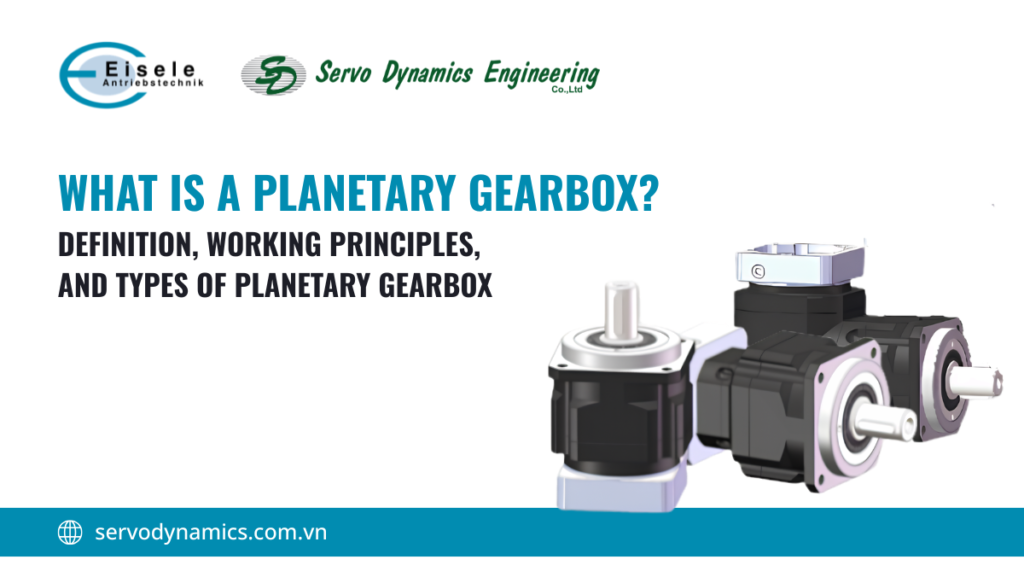
What is a Planetary Gearbox?
Definition of a Planetary Gearbox
A planetary gearbox (also known as an epicyclic gear train) is a gear transmission mechanism in which one or more “planet” gears revolve around a central “sun” gear. All of these gears are enclosed and meshed by an internal ring gear.
Unlike a conventional spur gearbox, which transmits drive along a simple straight or parallel line, a planetary gearbox shares the load across multiple meshing points simultaneously. This specific characteristic forms the core difference in performance.
Detailed Structure of a Planetary Gearbox
A planetary gearbox assembly consists of the following main components:
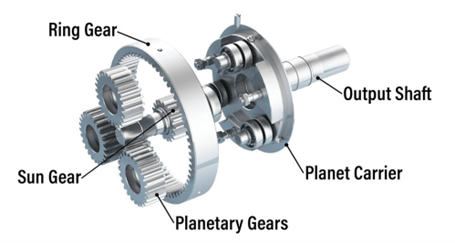
- Sun Gear: Located at the symmetrical center of the entire system, it receives torque directly from the motor and acts as the primary power-transmitting central gear. It is usually the smallest in size but experiences the highest rotational speed in the system. It is typically manufactured from high-strength alloy steel to resist wear.
- Planet Gears: A set of small gears (ranging from 3 to 5 gears) that revolve around the sun gear.
- Planet Carrier: The mechanical frame that holds and connects the planet gears in place.
- Ring Gear (Annulus): The outer bounding gear that meshes with the planet gears.
- Spur or Helical Gear: The construction of a planetary gear set can include either spur or helical gears. The difference between these two types lies in the helix angle of the teeth; specifically, spur gears have a helix angle of 0°, whereas helical gears feature a helix angle ranging from 10° to 30°
Operating Principle of a Planetary Gearbox
Fundamentally, a planetary gearbox operates through four cycles:
- The sun gear is located at the center, receiving power directly from the motor.
- Upon receiving power transmission from the sun gear, the planet gears simultaneously rotate on their own axes and orbit around the sun gear.
- As the planet gears move, they drive the planet carrier to rotate in the same direction. The planet carrier gathers the combined force from all planet gears, neutralizing radial forces and evenly distributing stress across the tooth surfaces.
- The planet carrier acts as the output shaft, generating a low-speed rotational movement that is inversely proportional to high torque.
Advantages of planetary gearbox design
- Neutralization of Radial Forces: Due to the symmetrical arrangement of the planet gears around the sun gear, the mesh forces are evenly distributed and cancel each other out. Consequently, the pure load acting on the shaft is solely torque, allowing for optimized bearing sizes and extending the lifespan of the system.
- Increased Torque Density: Designing multiple simultaneous meshing points helps distribute the load. Therefore, even with gears that have a small module, the system is capable of transmitting extremely large torque. Increasing the number of planet gears will enhance the torsional rigidity and load capacity of the planetary gearbox.
Operational Characteristics
- Optimization of Frictional Losses: Unlike worm drives or sliding gears, the planetary mechanism operates based on the principle of rolling contact, which significantly reduces the coefficient of friction, helping the system achieve high transmission efficiency (typically > 95% per integrated stage).
- Precision and Durability: The combination of a coaxial design and load-sharing capabilities helps maintain backlash at the lowest level and ensures precise alignment of motion, making it suitable for production lines that require high power density and long-term operational reliability.
Gear Ratio Calculation
When the sun gear acts as the input and the ring gear is fixed, the planet gears roll between them and rotate the planet carrier at a reduced speed. The gear ratio is determined by the number of teeth on the sun gear and the ring gear according to the formula:
| Gear Ratio = 1 + (Number of Teeth on the Ring Gear)/(Number of Teeth on the Sun Gear) |
For example: With a sun gear of 16 teeth and a ring gear of 48 teeth, the gear ratio is 4:1—meaning the planet carrier completes 1 rotation for every 4 rotations of the sun gear.
Functions of a Planetary Gearbox
The functions of a planetary gearbox in drive systems can be divided into the following key technical roles:
Speed & precise control optimization
- Lowers rotational speed and increases resolution: Reducing the speed from the motor helps increase accuracy during positioning control, which is particularly vital in Servo systems and Robotics.
- Optimal efficiency range: A planetary gearbox brings the motor to work within the RPM range that yields the highest efficiency, avoiding energy waste and reducing overheating issues.
Torque & load capacity multiplication
- Increase peak tractive force: Thanks to the principle of multiplying torque according to the gear ratio, the system can operate heavy loads while still using compact-sized motors.
- Multi-point load sharing: Unilke conventional spur gears that only make contact at a single point, planet gears share the load evenly across multiple satellite gears. This enhances instant load-carrying capacity and reduces stress on each individual tooth.
Structural & coaxial drive protection
- Neutralization of bending Momens: The symmetrical design allows radial forces to self-cancel, eliminating bending moments that can bend the shaft.
- Motor protection: Reduces direct mechanical loads on the bearings and motor shaft, helping to extend the lifespan of the entire drive assembly.
- Coaxial design: The input and output shafts lie on the same straight line, making installation simpler and more aesthetically pleasing.
Space & power density optimization
- Ultra-compact size: Achieves a high reduction ratio within a very limited space. Compared to a spur gear of the same power rating, a planetary gearbox can save up to 30-50% of installation space.
- High power output density: Transmits greater energy per unit of volume, making it the ideal solution for mobile applications or tight spaces.
Flexible gear ratio adjustments
- Diverse modes: With just one gear set, it is possible to create modes for: reduction, acceleration, or reverse rotation.
- Multi-staging: Multiple planetary stages can easily be stacked in series to achieve extremely large gear ratios (e.g., 100:1 or 1000:1) while keeping the outer diameter of the gearbox body exactly the same.
Distribution and sharing of operational loads
- Increased durability: Reduces stress on each individual tooth, thereby extending the lifespan of the transmission.
- Stiffness: Offers better resistance to shock loads and dynamic loads, making it highly suitable for precision robotic applications or F&B packaging machinery.
Calibration of Precision and Backlash
In motion control, the planetary gearbox acts as a bridge that ensures positioning accuracy.
- Backlash reduction: Due to multiple simultaneous meshing points, accumulated errors are minimized, helping the output shaft stop and move with ultra-high precision (measured in arcmin).
- Inertia: Helps smooth out signal feedback from the load back to the motor, preventing oscillation when stopping abruptly or reversing direction.
Benefits of using a planetary gearbox
- High operating efficiency: The structure of planetary gears operates mainly on rolling contact; as a result, frictional losses are kept low and transmission efficiency typically exceeds 95% per stage. Unlike conventional gear transmission technologies, the planetary design features high dynamic balance, which helps neutralize vibrations and minimize noise thanks to the characteristic of multiple teeth meshing simultaneously.
- Wide range of gear ratios: Planetary gearboxes offer a wide selection of gear ratios, ranging from 3:1 to 100:1; notably, additional internal gear sets can be integrated to create ratios up to 1000:1. These high ratios are achieved by cascading additional gear stages while maintaining a coaxial layout. This flexibility allows design engineers to fine-tune the output speed and torque to suit specific applications without needing to change the motor.
- Increased mechanical resolution: Because the gearbox acts to subdivide the motor’s rotation, the output shaft moves more smoothly and precisely. The resolution of the entire system increases exactly according to the gear ratio of the gearbox. This benefits:
- Precise control: Helps robotic arms or CNC machines move with extreme meticulousness at small distances.
- Motor utilization: Eliminates the need to invest in expensive encoders on the motor while still achieving the desired accuracy at the output.
Classification of planetary gearbox
Depending on the drive structure, space requirements, and accuracy demands, planetary gearboxes are divided into the following main groups:
According to the Number of Stages
- Single Stage: Uses a single set of planetary gears. The gear ratio typically falls within the range of 3:1 to 10:1. The advantages are ultra-high efficiency and an extremely compact design.
- Multi-Stage: Connects multiple planetary gear sets in series. This allows for very large gear ratios (up to thousands) within a size that remains much smaller than other types of gearboxes with the same ratio.
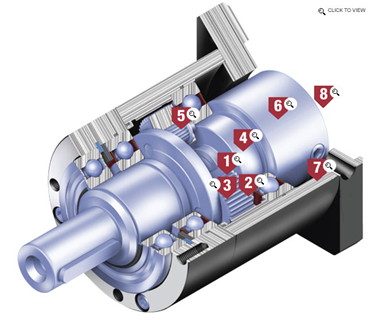
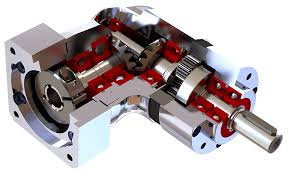
According to Shaft Structure (In-Line vs. Right-Angle)
|
 |
|
 |
Specialized & Complex Planetary Gearbox Series
Harmonic Drive (Strain Wave Gearbox):
- Features zero backlash and extremely large gear ratios despite a lightweight and compact design.
- Used primarily in collaborative robots, aerospace, and medical equipment.
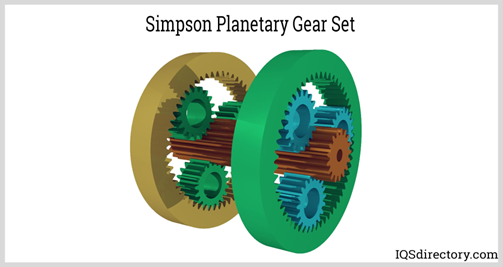
Simpson Planetary Gearbox:
| Consists of a single sun gear combined with two or three planetary carriers connected in series.
It typically provides 3 forward gears, 1 reverse gear, and a neutral gear. Common in older automatic transmission systems. |
 |
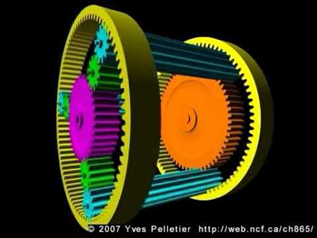
Ravigneaux Planetary Gearbox:
An upgrade over the Simpson system with a more complex structure: 2 sun gears, 2 ring gears, and 2 sets of planet gears on a single carrier.It allows for more gear steps within a smaller machinery space. |
 |
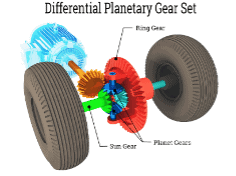
Differential Planetary Gearbox:
| Designed with a large ring gear, a planet carrier, and a sun gear flexibly connected.
It allows for rotational speed variation between two output shafts while receiving a shared power source from the drive shaft. |
 |
Points to considerate when selecting a planetary gearbox
Gear ratio and inertia reduction:
You should choose a gear ratio that provides sufficient torque without excessively restricting the motor’s speed. Engineers need to calculate the square of the gear ratio to verify whether the reflected inertia falls within the torque and acceleration limits of the motor.
Available physical space and frame size:
The planetary gearbox will increase the overall length of the drive system. It is necessary to make sure that the frame size (e.g., NEMA 23, 34, or equivalent standards) matches the motor and fits the installation space. Note that multi-stage planetary gearboxes will be longer than single-stage ones.
Torque requirements of the motor system:
Engineers should analyze the load characteristics to determine continuous torque, peak torque (during acceleration), and emergency stop torque. Also, you need to ensure that the rated specifications of the planetary gearbox exceed these requirements with a suitable safety factor.
Radial & axial loads:
Although planetary gearboxes typically feature oversized output bearings, you still need to account for belt tension, misalignment, gravity, or thrust forces acting on the output shaft. Compare your requirements with the technical specifications of the planetary gearbox.
Backlash and rigidity of the planetary gearbox:
Even precision planetary gearboxes exhibit a certain amount of backlash and elasticity. Compare the manufacturer’s specifications with the positioning tolerances in your design and select the option with the highest rigidity within practical limits.
Noise, vibration, and lubrication:
At high speeds, the meshing of gears can generate significant noise. Consider the dB rating and prioritize reducers with high-precision machined gears. Additionally, factor in whether the application requires sealed life-time lubrication or periodic maintenance.
Applications of planetary gearbox in industrial automation
In the field of industrial automation, planetary gearboxes serve as a core component for precise, stable transmission and optimal performance in machinery systems:
Industrial valve actuator systems
Planetary gearboxes are used in valve actuators where precise control of the open/close position is required.
- Ensures sufficient torque to operate large-sized valves.
- Increases accuracy in fluid/gas flow control.
- Operates stably in harsh environments.
Automatic door and open/close mechanisms
In factories, logistics centers, or cleanroom systems, automatic doors require high reliability. Therefore, planetary gearboxes can be applied to:
- Provide smooth, jerk-free opening and closing motions, reducing accidents.
- Optimize speed and pulling force.
- Reduce wear compared to conventional drives.
Electric screwdrivers and automated assembly equipments
In production lines (especially electronics and automotive), electric screwdrivers require highly precise tightening torque control:
- Planetary gearboxes help maintain stable torque.
- Increase repeatability during the tightening process.
- Minimize errors caused by over-tightening or under-tightening.
Industrial robots and cobots
- Planetary gearboxes increase the positioning accuracy of each robot joint.
- Ensure smooth movement and reduce vibration.
- Handle loads well in pick-and-place, palletizing, welding, and assembly applications.
Conveyor systems and linear drives
In production lines, a planetary gearbox can help to:
- Adjust conveyor speed precisely.
- Increase heavy load-carrying capacity while keeping dimensions compact.
- Ensure continuous operation with high efficiency.
Eisele – Specialized solutions for planetary gearbox requirements
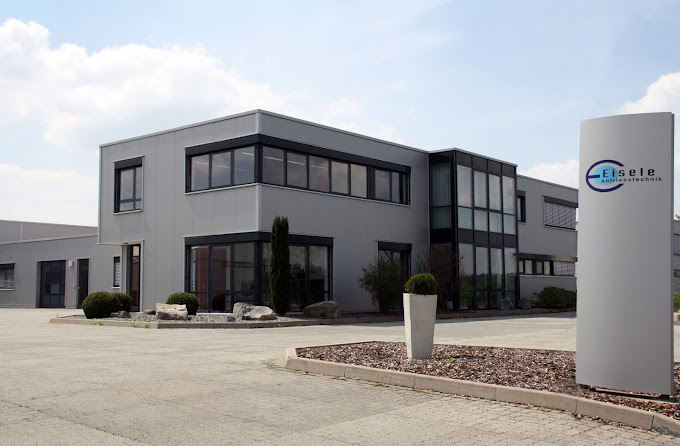
Eisele Antriebstechnik specializes in providing high-precision mechanical drive solutions, particularly for industrial applications that require customization and long-term reliability.
EPL – Economy / General Purpose Series
EPL is Eisele’s baseline planetary gearbox product line, suitable for all automation cycles, from conveyors and packaging machines to basic mechanical machinery:
- Compact, coaxial design.
- Torque: approximately 5–500 Nm.
- Low backlash (≈ 6–10 arcmin).
- Available in multiple alternatives: solid shaft, hollow shaft, and stepper-motor mounting.
EPL-FE – Flange Output Series
EPL-FE is an upgraded version of the EPL series featuring an output flange. Because it must endure direct loads, the EPL-FE series features a more robust construction. It is ideal for applications such as robotic arms or indexing rotary tables:
- Output flange design according to DIN EN ISO 9409.
- Torque: approximately 16–540 Nm, optimized for high radial and axial loads.
- Lower backlash than the EPL series: approximately 5–8 arcmin.
ESP – Precision Series
ESP is the premium series regarding precision, optimizing torsional rigidity and making it ideal for high-end servo motors. It can be well utilized in CNC cutting machines, high-precision robotic equipment, or measuring devices:
- Features bearings and preloading designed to reduce deformation, alongside high-precision machined gear structures.
- Ultra-low backlash ($\approx$ 3–5 arcmin).
- Higher torque: up to approximately 13–1300 Nm.
- Higher torsional rigidity compared to the EPL series.
EPL-AE – Series for Food & Pharmaceutical Environments
EPL-AE is a variant of the EPL series optimized for cycles that demand strict hygiene maintenance, such as in food and medicine production or packaging lines:
- Output shaft design made of stainless steel, capable of bearing high loads thanks to tapered roller bearings.
- Can utilize food-grade lubrication grease.
- IP65 protection standard or higher, suitable for high-humidity environments.
REG-P – Modular Series with flexible configuration
REG-P is a newly released series that offers flexible configuration. This is the right choice for entire systems targeting OEMs and machinery that require specific customized details:
- Modular design allowing adjustments to: gear ratio, input/output styles, and mounting configurations.
- Optimized performance and flexibility.
- Suitable for systems requiring highly distinct designs.
Servo Dynamics Engineering: Authorized Distributor for Eisele Antriebstechnik Planetary Gearbox Products in Vietnam
Servo Dynamics Engineering is a trusted distribution partner specialized in providing premium planetary gearbox product lines from Eisele Antriebstechnik in the Vietnamese market. Servo proudly delivers comprehensive industrial drive solutions from Eisele, helping businesses optimize mechanical performance, guarantee absolute precision, and maintain durable operations for their machinery systems.
- German Manufacturing Technology with Optimal Precision: The Eisele Antriebstechnik planetary gearbox series features pinnacle mechanical design with ultra-low backlash, large torque capacity, and superior transmission efficiency. The load distribution design across the planet gears ensures smooth system operation, perfectly meeting the needs of motion control applications that demand strict precision and continuous acceleration/deceleration cycles of servo motors.
- Optimized for performance and operational costs: Servo is committed to delivering optimal solutions that help businesses minimize mechanical wear, extend drive system lifespan, and maximize ROI by reducing unexpected downtime repair costs to a minimum.
- In-Depth Technical Support: Servo’s engineering team is rigorously trained and highly experienced, standing ready to support customers with consulting on the most precise mechanical integration methods into the overall mechatronics system of the factory.
- Comprehensive After-Sales Service: Beyond simply supplying equipment, Servo accompanies businesses throughout the entire product lifecycle by offering practical technical consulting services, installation support, high-precision mechanical alignment, routine maintenance, and rapid troubleshooting for drive systems.