Tiếng Việt
Consulting, Fire & Safety
What is a Fire Alarm Horn? Detailed Classification and International Standard Installation Guide
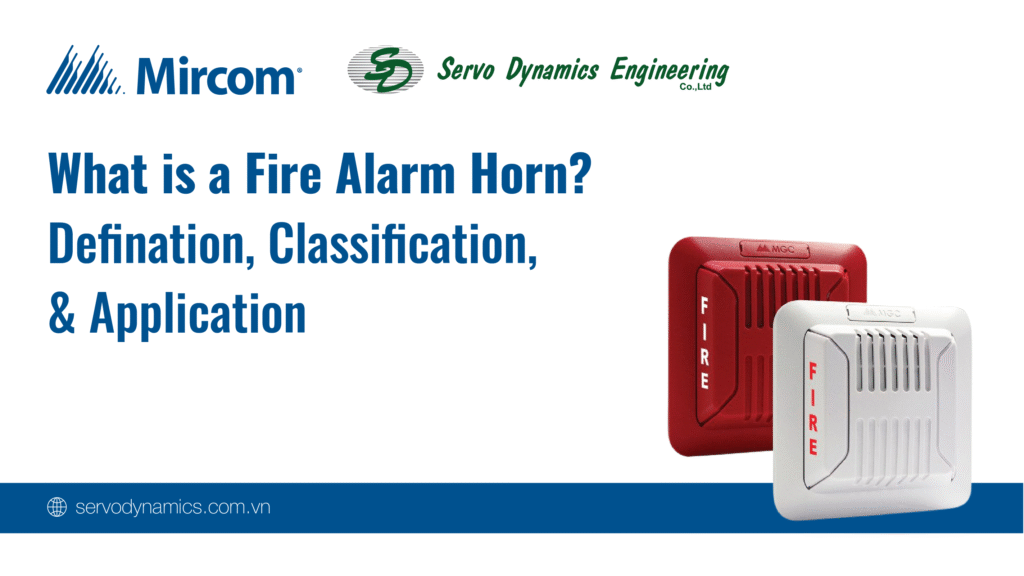
In any modern construction, from high-rise apartments and commercial centers to industrial factories, the fire alarm horn serves as the “emergency language” to quickly and effectively convey the message for evacuation.
This article provides the most detailed overview of this critically important warning device: from its definition, operating principle, technical feature classification, to precise standard installation instructions, and a summary of leading reputable models on the market today.
What is a Fire Alarm Horn?

Fire Alarm Horn Definition
What is a Fire Alarm Horn? (Fire Alarm Device, Fire Alarm Siren, Fire Alert Horn)
A Fire Alarm Horn (Horn/Strobe) is an indispensable end device (output device) in the Fire Prevention and Fighting (PCCC) system. Its function is to convert the alarm command from the Fire Alarm Control Panel (FACP) into audible (horn, bell, siren) and/or visual (strobe light) warning signals.
The main goal of the fire alarm horn is to create a high-intensity sound level, usually exceeding 100dB at 3 meters, to ensure everyone in the area can hear the warning signal, even in noisy environments or while sleeping.
The Role of the Fire Alarm Horn in the Fire Protection System
The fire alarm horn performs a multi-faceted role, not merely generating noise:
- Timely Warning: It is the immediate reaction mechanism after a detector senses smoke or heat, allowing occupants precious time to evacuate.
- Evacuation Guidance: Standardized audible signals (such as Temporal Code 3) help people recognize this as a genuine fire alarm, distinct from a burglar alarm or other incidents.
- Assistance for the Hearing Impaired: For combined horn strobe devices, the high-intensity strobe light provides a visual warning, strictly complying with the UL 1971 standard for individuals with hearing loss.
Distinguishing Alarm Signal Types
Fire Alarm Sound vs. Fire Alarm Horn Sound
| Signal Type | Characteristics | Application |
| Fire Alarm Horn Sound (Horn/Bell) | Mechanical (bell) or electromagnetic (horn) sound following the Temporal Code 3 standard (3 short beeps, pauses, repeated). | Conventional and Addressable fire alarm systems. |
| Fire Alarm Sound (Voice Evacuation/Speaker) | Pre-recorded voice messages providing clear evacuation instructions (e.g., “Fire emergency on the 5th floor. Please use the nearest exit route”). | Shopping centers, airports, hospitals, complex buildings requiring phased evacuation. |
Fire Alarm Horn Operating Principle
When does the fire alarm horn sound? The warning signal is emitted through a strictly controlled cycle:
- Detection: A smoke/heat detector sends a signal to the Fire Alarm Control Panel (FACP).
- Confirmation and Activation: The FACP processes and confirms the alarm condition.
- NAC Power Supply: The FACP immediately supplies stable electrical power (typically 24VDC) to the Notification Appliance Circuit (NAC).
- Signal Emission: The fire alarm horn (when wired with correct polarity) receives this 24VDC power and activates the electromagnetic diaphragm to generate the Temporal 3 sound, while simultaneously activating the strobe light (if present) at a frequency of 1Hz (one flash per second).
Common Fire Alarm Horn Classification by Features and Technical Specifications
Detailed classification helps select the appropriate device for the installation environment and specific safety standards.
Classification by Structure and Features
Combined Horn Strobe (Horn Strobe)
This is the most common type today, integrating both audible (horn/siren) and visual (strobe) warnings in one device.
- Multi-Candela Feature: High-end horn strobe lines like Mircom L-Series or Hochiki HEC3 allow installers to customize the strobe light intensity (Candela – cd) directly in the field. Common options include 15cd, 30cd, 75cd, 110cd, 135cd, and 185cd, allowing optimization of light coverage and reduction of current consumption.
- Synchronization: Strobe lights must be synchronized so that all strobes in the same area flash simultaneously. This not only creates a stronger visual effect but also complies with the UL 1971 standard to prevent seizures caused by irregular flashing frequencies.
Explosion-Proof Horn Strobe
These are specialized devices for hazardous environments where explosive gases, chemical vapors, or combustible dust exist (e.g., fuel depots, chemical plants, mining areas).
- Characteristics: The horn is encased in a sealed, pressure-resistant, and corrosion-resistant metal housing. They are designed to:
- Prevent internal electrical sparks from escaping and igniting the explosive gas/dust mixture.
- Withstand the pressure from an internal explosion (if any) without damaging the external casing.
- Mandatory Standards: Explosion-proof horns must have special certifications such as ATEX (Europe), CENELEC, or meet protection standards like IP65 (complete dust protection and low-pressure water resistance) or NEMA 4X (corrosion and weather resistance).
Classification by Power Supply and Connection
| Fire Alarm Horn Type | Nominal Voltage | Operating Voltage Range | Note |
| 12V Fire Alarm Horn | 12VDC | 8V to 17.5VDC | Often used for burglar alarm systems or very small-scale fire protection systems. |
| 24V Fire Alarm Horn | 24VDC | 16V to 33VDC (or FWR) | Industry Standard. Uses a wide voltage range to maintain operation even when backup battery voltage drops. |
| 220V Fire Alarm Horn | 220VAC | 200V to 240VAC | High-power industrial horn/siren. Requires a relay or control module to receive commands from the 24VDC NAC. |
| Wireless Fire Alarm Horn | Battery | Uses lithium or rechargeable batteries | Connects to the main control panel via radio frequency (RF). Convenient for supplementary installation or areas where wiring is difficult. |
Top Fire Alarm Horn Brands
Mircom Fire Alarm Horn (Canada)
Mircom is a world-leading group in the fire protection industry, renowned for high-reliability warning devices that meet strict international certifications such as UL, FM, and ULC.
- Key Technology: Mircom applies advanced technology in its warning devices, including stable operation across a wide voltage range, ensuring performance even if the backup battery system degrades.
- Typical Fire Alarm Horn Series:
- 400 Series Fire Alarm Horn: This is Mircom’s durable, mainstream conventional horn line, designed to emit high-intensity sound, effective in commercial and industrial environments.
Hochiki Fire Alarm Horn
Hochiki (Japan) is famous for its outstanding durability and stable operation in varying environmental conditions.
GST Fire Alarm Horn
GST (Global System Technology) is a major fire protection solution provider from China, favored for its diversity and competitive pricing.
Horing, Dahua, and Other Brands
- Horing Fire Alarm Horn: A Taiwanese brand focusing on traditional horns, meeting basic PCCC needs with cost-effective investment.
- Dahua Fire Alarm Horn: Often warning devices integrated into Dahua’s smart security ecosystem.
- Other High-end Brands: Notifier, Nohmi, Siemens, System Sensor are industry giants, supplying equipment for large-scale projects requiring the strictest fire safety certifications.
Installation Guide and Troubleshooting Common Issues
Correct installation and maintenance are prerequisites for ensuring the fire alarm horn operates effectively.
Detailed Wiring and Installation of Fire Alarm Horns
Preparation and Notes Before Installation
- Check Polarity: Most 24VDC fire alarm horns are Polarity Sensitive. The positive (+) and negative (-) wires must be connected precisely.
- Height and Distance: Horn strobes should not be installed higher than 3m from the floor, and ensure 180-degree light coverage is unobstructed.
- Wiring: Use fire-resistant cable, minimum size 1.5mm2 or as calculated based on the current draw of the entire NAC circuit.
How to Connect Fire Alarm Horns to the System (NAC Circuit)
Fire alarm horns are wired according to the Supervised Parallel Wiring principle:
- Polarity Connection: Connect the (+) and (-) wires of the NAC circuit to the corresponding terminals on the horn’s base.
- End-of-Line Resistor (EOLR): This is the most crucial component. The End-of-Line Resistor must be installed at the last fire alarm horn on the circuit.
- Role: Under normal (Supervisory/Trouble) conditions, the FACP sends a small supervisory current through the EOLR. If the wire is cut, the FACP cannot measure the resistance, and it reports a Trouble condition. If the FACP sends 24VDC alarm power, it bypasses the EOLR and activates the horn. The EOLR ensures the integrity of the wiring 24/7.
Troubleshooting False Alarm Issues
Reasons Why the Fire Alarm Horn Sounds Unexpectedly
False Alarms are a common issue, causing operational instability. Common causes:
- Environment: High moisture concentration (bathrooms, open kitchens), thick accumulation of dust in the optical smoke chamber of the detector, or insect intrusion.
- Electrical Issues: Voltage drop on the NAC line, temporary short circuits, or electromagnetic interference.
- Operational Error: User accidentally presses a manual pull station.
Guide on How to Temporarily Silence the Horn and Resolve the Issue Completely
When the fire alarm horn sounds (alarm), you need to follow 3 standard steps:
- Acknowledge (ACK):
- Press the “Acknowledge” button on the FACP panel. This action registers the alarm, the alarm light on the panel illuminates, but the warning horn continues to sound.
- Silence Alarm:
- Press the “Silence Alarm” button on the FACP panel. This action stops the horn/bell sound and the strobe flash, allowing the operator to assess the situation. Note: The alarm/fire light on the panel remains illuminated.
- Reset:
- Only perform this after the cause of the false alarm has been eliminated.
- Press the “Reset” button on the FACP panel. The system will briefly cut power, clear the alarm status, and return all devices (horns, detectors) to normal supervisory status.
- If the horn immediately sounds again after Reset, it means the cause (smoke, dust, or technical error) has not been resolved.
Servo Dynamics Engineering: Authorized Distributor of Mircom in Vietnam
To ensure your fire alarm system complies with stringent international safety standards such as UL, FM, and ULC, using genuine equipment is mandatory.
Servo Dynamics Engineering is proud to be the official Authorized Distributor of Mircom (Canada) in the Vietnamese market. We are committed to providing:
- Mircom warning devices and other Mircom alarm solutions meet the highest international certifications.
- In-depth technical support from engineers directly trained by Mircom.
- Precise installation consultation, ensuring maximum operational efficiency of the Mircom alarm system for all projects.
Contact Servo Dynamics Engineering today for expert consultation on the top-quality Mircom fire alarm horn series, including the durable and effective 400 Series.